Showing posts with label Dorothy Moore Drafting Lessons. Show all posts

Monday, 4 July 2016

{Dorothy Moore} Lesson 2 Skirt Variations


Dorothy Moore presents a number of Instructions for drafting Skirt Variations: A-Line, Circle Skirt, Panel Skirts, a Wrap Around Skirt and yoked skirts.

I have drafted a slight A Line skirt with a yoke. (Instructions below)

My first version was up to the waist, made from stripey linen fabric with 4 panels cut on the bias (so you get a sort of chevron pattern in the front and at the sides)  and... it was awful. I didn't even finish it and didn't take a picture either. It was a bit much of everything. An abomination :) So I put the whole pattern and everything to the side, concentrated on other things and took it up again after several months had passed.

I don't usually like to wear my skirts right at the waist level (with pencil skirts it somehow works though...), so I used my pencil skirt as a guide for lowering the pattern down to the waist,  about 9 cms in total (just a bit more than 3 inch), that's quite low. I then added a yoke to the pattern following the instructions of Dorothy Moores's Lesson 2 so I could omit the waist darts. Et voilĂ !

Pattern for A Line Skirt with Yoke drafted to my measurements. Sorry, brown paper on wooden floor = not so good contrast. ;)

I've had 1 meter of this totall cute fabric in my stash, it's from Lewis & Irene "April Showers". Because it wasn't quite enough for a proper skirt, I added an underskirt. The underskirt is made of an old white cotton curtain (using the same pattern, just a bit longer) and I've had a bit of thin red zig-zag trim left which I added at the bottom of the underskirt. I didn't have enough fabric to cut the yoke in the same direction of the fabric, but I don't really mind.The invisible zipper is inserted on the left side. I've also added a tiny button and a bow. Can you find it? ;)


Due to rainy weather (I hope the choice of fabric didn't have anything to do with that...) I've not worn it yet.  

________________________
Total Cost 15,54 Euros
Umbrella Fabric : 15 Euros
Underskirt: Old Curtain 0 Euros
Trim and button from stash 0 Euros
invisible zipper 0,54 Cent

Here are the instructions  how to draft an A Line Skirt and A Yoked Skirt. You'll need to draft a Pencil Skirt first.

Dorothy Moore A Line Skirt

Dorothy Moore Yoke Skirt


Thursday, 17 March 2016

Preparing for {Dorothy Moore}

Taking your exact (i.e. honest...) measurements is essential to making your own clothes. Whether drafting patterns or altering them - you've go to know your measurements.

These are the measurements Dorothy Moore is working with for her pattern drafting course.

Before you take your measurements, think about what foundations you are going to wear with the garment you are going to draft - and then measure wearing those... (push-up)bra, shapewear, girdle, corset... they do make a difference...

Taking some of these measurements require a helping hand...  and an elastic band around the waist to indicate the waistline properly.


tie an elastic band around your waist and move around a bit so it settles were your natural waist is!

neckline is low, about where the collar bone is!

use elastic band at waist again

did I mention the elastic waistband?

CAVE: crotch measurement taken slightly angled to the front, not straight


then fill them in these sheets for better reference:


Sunday, 21 February 2016

{Dorothy Moore} Lesson 4 Basic Top

I didn't have enough brown paper to draft the trousers pattern (Lesson 3) and for the Lesson 2 "Skirt Variations" I still have to get a few notions (I have drafted an A-Line Yoke skirt already) so I am continueing unchronologically with Lesson 4 - a basic top.

The basic top pattern is used for all other patterns following in the book -> sheath dress, blouses, coats... so it is really the centre of all pattern/clothes-making and thus it is important to fit it well.


You first draft a basic top pattern


which you then adjust to the waist measurements and add darts


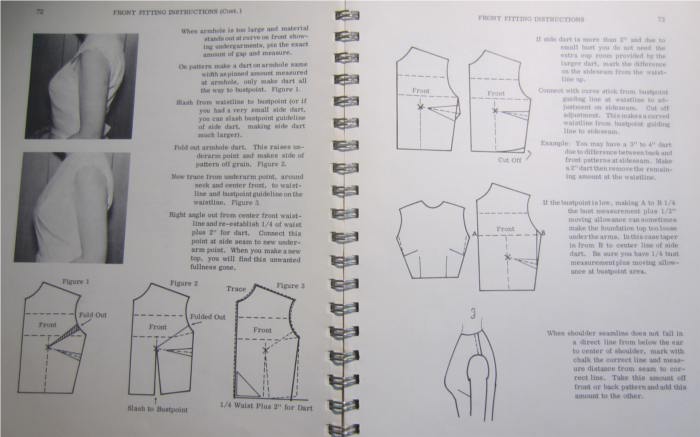
After making a muslin top from the first foundation top pattern you have to make what she calls "minor adjustments" to adjust this pattern to your shape. e.g. wide shoulder blades, gaping neckline, armhole gap, round upper back, low bust point, smaller cup room ...
I needed to make adjustments for a gap at the front armhole  following these steps. I also noticed I had taken a slightly too wide "shoulder-to-shoulder" measurement, so noted the right measurement now and shortened the shoulder seam length by about 1 cm.


this what my pattern looks like (final version)


I forgot to take a picture of me wearing the mock-up, but this is what it looks like in its final version. :)


I really enjoyed the drawing for this pattern, it was really straight forward, the changes I had to make were minor and easy to do and I think I achieved an acceptable fit without too much effort.


After completing the Lesson 2 (Skirt Variations" A-Line Skirt with yoke) I am going to spend some time on a top with this pattern. It's going to be the green fan vest from Marilyn Monroes "Bauman sitting" (1954). To go with the dark blue pencil skirt from Lesson 1. ;)

Friday, 19 February 2016

{Dorothy Moore} Lesson 1 Straight Skirt

Dorothy Moore's Patternsdrafting and Dressmaking

Lesson 1 - Straight Skirt


In other words...  how to draft a classic Pencil Skirt.


Out of general doziness I drafted the first skirt with wrong measurements and then started to wonder, why it didn't fit ... ah well.. so I drafted it again.
I then tried out a version for "big ratio for waist and lower hips/thighs", which suggested darts slanted towards the hip bone. I didn't quite like the outcome (hence no picture) and just went with the normal darts that I had to extend 1 inch in the skirt front piece to achieve a smoother fit in the mock-up.

This is what the drafting scheme looks like:


I wanted the pencil skirt to be quite "wiggly" so I didn't just use the straight skirt pattern but took the side seam in a bit: from the hip point I used the curve stick and tapered in slightly and then out again to the original seam. It's only about a centimetre (1/2 inch) at the most, but it does make a difference, I think.

I then stumbled across about 1,6m of a nice looking fabric at a local sale, and albeit being Polyester I took it with me (along with some lining fabric). It's a medium weight fabric suitable for suits in a very very dark blue. I don't usually go for Polyester. I don't ususally go for dark blue, either. :) The lining fabric is a very dark aubergine coloured Polyester (again...), I used the less shiny side as my "right" side. :)

I basted the fabric and lining together and then treated it as one layer (more in the sense of an underlining) because I wanted to try it out. :) The good thing about an underlining is that the nice outer fabric gets a bit of support and you can also make an invisible hem. I also inserted an "invisible" zipper. Now I might have to be careful I don't turn invisible myself. :)

I've not taken many construction pictures, it's just a skirt, really.

I fact I have only taken 1 construction picture. You can see the underlining with the darts marked and then center basted through all layers and partly pinned together.


And voilĂ , the all-over result:

[I am looking a bit strange on these... I've got a nasty cold and somebody elses's voice which didn't really make me feel like dressing up a lot and putting on make-up. I did make an effort putting on nice shoes, though.]

The skirt also needs a bit more ironing.. I know...


as you can see, you can't really see the kick pleat, but I promise, it's there...


For an easy step by step introduction on how to sew a pencil skirt for beginners refer to this site, her instructions are quite good and she's got a good sense of humour, too. :)
http://blog.tuppencehapenny.co.uk/2012/11/beginner-sew-along-1-yard-pencil-skirt.html

Friday, 22 January 2016

Introduction to Dorothy Moore's Pattern Drafting and Dressmaking


As the result for my weakness for retro fashion (namely the 1950s-60s...) and after analysing quite a lot of pictures of clothes of that time, I found that one very big issue is the actual accurate fit of the garment. Something I've so far tried to ignore as much as possible. :)

While dwelling in the 18th century (sewing wise...), I found, that the proper fitting of the clothes is the key to the right look... and it made me rethink my rather casual attitude towards fitting of modern clothes. In other words: I would now prefer my 20th/21st century clothes to fit as well as my 18th century clothes. I really want to learn now and understand sewing and start doing it properly (instead of intuitively....)

My first step to understanding more about sewing techniques and patterns is to follow, page by page, lesson by lesson the book by Dorothy Moore "Pattern drafting and Dressmaking" from 1971. The plan is to follow all the instructions, understand what I am doing and to end up with innumerous muslin pieces. :)

- The book is meant to be a coursebook with 15 lesson on pattern drafting, only very basic notes on assembly are included. 
- To help me with the actual sewing techniques, I am using "Vogue Sewing" from 2006 (editor Crystal McDougald) (and the internet....).

The chapters will always be easily accessible via the page "Dorothy Moore's Patterndrafting and Dressmaking" at the top.

Before I could start drafting and cutting and sewing, I had to accomplish a few tasks, though...

1. obviously to do a lot of reading in the afore mentioned books (done that, but doesn't look very exciting, so I will spare you the details)

2. to acquire the necessary tools (fashion rulers, namely a hip curve and a big 90degree angle/set square) and brown paper and scrap fabric for the muslins.

3. to take the my correct measurements (which will remain secret for now)

4. do the preliminary "foundation work" (and take measurement with those, too, where necessary)


(Without being too indiscreet I think I can say, that the correct foundations for the time have an enormous impact on the appearance and fit of the garment. For example, without stays, a robe a l'anglaise (18th century) wouldn't look right. And you can't just use the same 18th century stays in the mid 19th century - it would look completely wrong. You'd have to make a proper corset to measure. So, in all cases, always wear the appropriate underwear. Whatever time you are sewing for: know your undies!)

So after all the preparation work and reading I started with Preparing for Dorothy (link with info about the foundations to follow when finished...) :)

(PS: I am not using a tailor's dummy for now, because I found making the changes on myself (and then transferring them directly to the patterns) works better for me... I just don't get that plastic thing to have my shape...)