When I made this wig, I didn't take any pictures, unfortunately, because
I wasn't even sure how it would turn out. It turned out well (I think) and now I
am a bit annoyed I have no pictures for a proper tutorial. I did a few
drawings instead and am trying to describe what I was doing and how. If
there are any problems, just let me know, maybe I can explain better. Also for the moment I haven't got better pictures, but I promise to add them ASAP. I wanted to get the tutorial out as soon as possible. :)
Pictures with very silly big cap and sockets. :)
I've made the instructions on paper, you can view and download them as a pdf. :)
https://goo.gl/EtF239
I have used
mesh wire
about 20x30cms
The holes are about 2-3cms (1 inch) wide
2 wigs (long hair, wavy or curly, no fringe; I have used lace front, but that's up to you; be careful with the colour, I have chosen something that is sort of similar to my own hair, and yes, it is synthetic.)
batting for the mesh wire "cage" (I used a piece of Vlieseline H640, because it was there. Just choose something that is softish to cover the "cage").
lots of pins
enormous amounts of hair spray and a bit of foam
lots of patience
You can find inspiration for hairdos on paintings and I found these drawings quite helpful. http://www.coiffure-ducher.fr/louisxvi_femdescr.html
As usual, I didn't copy anything in particular but just "absorbed" all the sources and then made something up that I think works for the 1770s. I have to admit though, that I might have looks at mid 20th century hairdos, I don't know why, I think I have made a set of victory rolls there... I like anachronisms though. And again it shows how much we are children of our own time...
I hope the tutorial is helpful, if you have any questions, just leave a comment below.
wearing experience: after wearing the wig for an entire evening, I now know, why posture was so essential "back then". Despite my wig being very well secured to my head and reasonably well balanced, it does have quite a bit of weight and being a rather lively person (pulling faces, turning my head quickly ....) I felt it forced me to move more ... elegant... and slower... and while it suited the evening and the whole ensemble (the "Landgravine Anglaise"), I wouldn't want to wear it on a daily basis. I am too 21st century. ;)
Showing posts with label hair. Show all posts
Monday, 26 October 2015
Sunday, 5 October 2014
Oh help! Oh no! It's A Calash!
I am reading the Gruffalo a lot with our little daughter and when I came to writing this post about my latest project, I couldn't help thinking in those words.
Anyway. It was a rather spontaneous project which had the purpose of keeping my mind busy (for various reasons) and being inexpensive. So, I've been thinking about a calash for some time and had looked at some pictures, and now the time was ripe.
I've still had plenty of reed and some silks left over.
Calash (or Calèche) is a horse carriage, really. (read more here at Wikipeda e.g. )
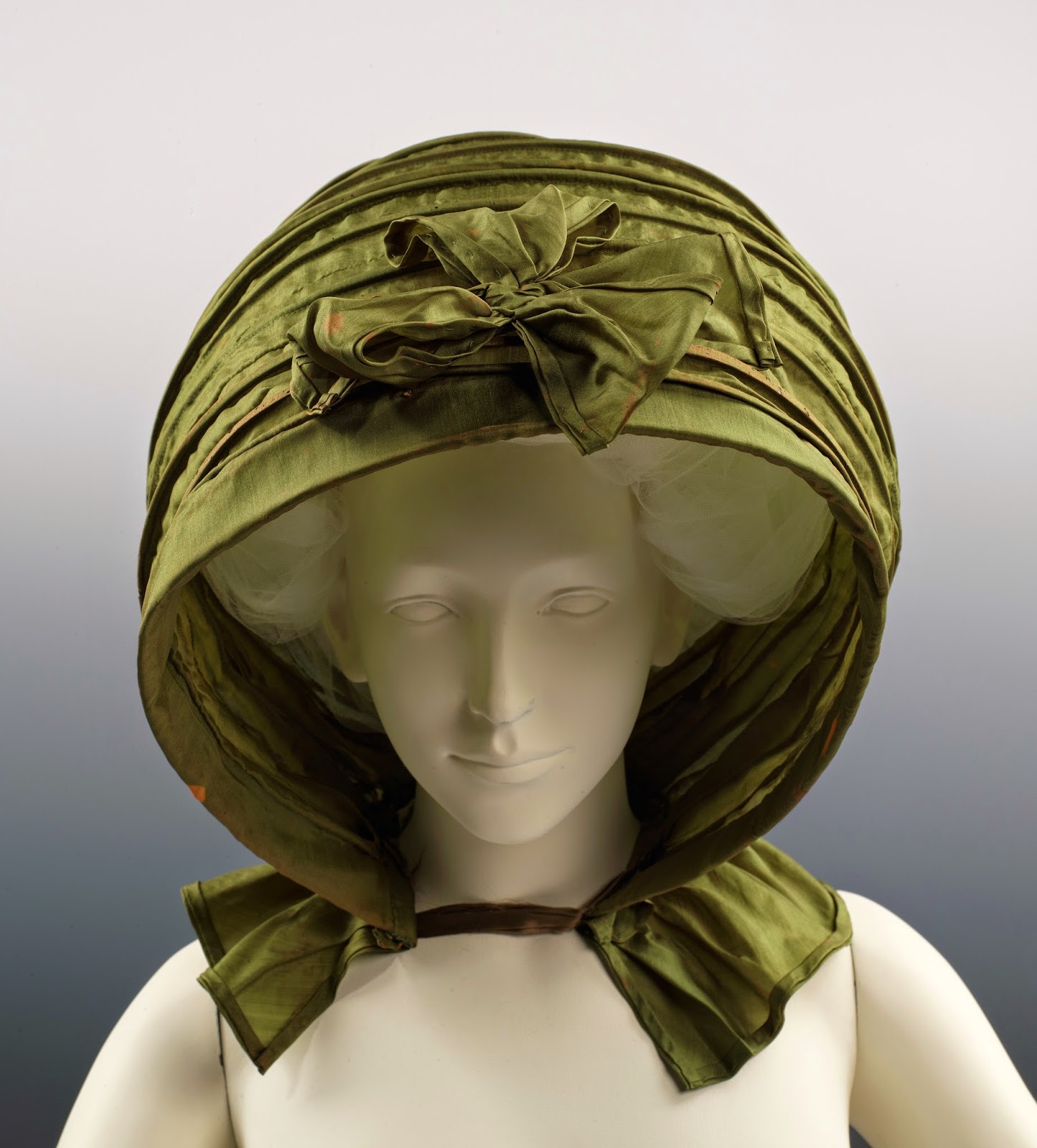
First a quick analyses of the calashes I used as examples. They can be found on the metmuseum.org homepage. Also refer to my pinterest board for more examples or this homepage, that has plenty of links to museums
http://www.metmuseum.org/collection/the-collection-online/search/116612?=&imgNo=0&tabName=related-objects
http://www.metmuseum.org/collection/the-collection-online/search/157763?img=1&imgNo=0&tabName=related-objects
If you follow the links you will find a few more photographs. The MetMuseum has some other Calashes from the 18th and early 19th century and also Pinterest is a good source for finding more pictures.
From those (and a few more, but let's not get overly into this) I have deducted the following things for my project:
1. The calash itself is based on a rectangle. The size of the rectangle is determined by the height and depth you want ot achieve. I noticed that in the above examples the boning seems to be "riding" on top of the calash. I assume, that first the lining is mounted to the outside fabric and then the tunnels are sewn through all layers. The reed probably has a distance of 2 inches. And in between there seems to be either a gathering stitch or an actual seem to allow that accordeon-like folding.
2. The back is either just the rest of the rectangle gathered and cut to fit into that sort of horse-shape OR it is a neatly cut flat extra piece of fabric and lining. Most calashes seem to have a ribbon in the back.
3. A ruffle (at least, could also extend to a "nearly-cape" length) was attached to the bottom of the calash and a ribbon in front to secure it and keep it in shape. Also seems to be a simple rectangle mostly.
4. Some calashes have (like the green one above) extra decoration (I love that extra bow on the green one!).
5. Although you don't see them on the pictures, I would think they had a small ribbon somewhere to pull them up agains the wind and over the head.
6. Both calashes have a sort of brim in the front, the green one has a rather straight one that might be padded with an extra layer of stiffer fabric, the violet one has some sort of double ruffle. Anyway, neither of them ends with a bone but with something decorative.
Personally I like the shape of the green one best, not very bulky and ruffly. So that's the shape I was trying to achieve.
13 boning chanels, 2 thereof in the back so slightly shorter. aprox. 2 inches apart?
in between fold to the inside, w/o boning.
2 bows.
supposedly flat back.
simple straight brim in front, possibly stiffened.
simple self fabric ties.
I've had particular fun with the reed I've used. It came in a round bundle and gave the whole thing the shape of an orange. But I wanted horse-shoe. My mock-up wasn't promising. So after doing some research into reed (which led me to most informative sited about basket making...) I've learned a lot of new stuff. Did it help the calash? Who knows.
So here we are, this is my version of a calash. Sorry, no big hair day... :)
| Also not a big smiley face day. Could be worse, though. |
| my favourite view. |
And for everyone who's made it this far: Here's an experimental pattern. It's not complete and will still take a bit of fiddling I'm afraid, but then I'm not a professional pattern person and it's free. ;) The pattern is in English. Sort of.
Calash Pattern.pdf
Enjoy your day!
(PS: No, it's not entirely handsewn, I've used the machine a fair bit, because I wasn't convinced it would turn out okay... shame on me... I would recommend sewing the boning channels on the outside by hand, though... if you want to do it half-properly... but well... next time...)
Saturday, 30 November 2013
Schloss Bruchsal Update
Just a few small additions to the Post about the Bruchsal Rococo Ball, thank you Michael and Diana!!!
And thank you to everyone who made this day and evening special and fun!
By the way: I noticed on these pictures how awfully modern I was dressed. ;) late 1780s... wohooo.... should have worn my Francaise, but then everybody else would have been wearing their Anglaise-dresses, i guess. ;)
All pictures have COPYRIGHT!
And thank you to everyone who made this day and evening special and fun!
By the way: I noticed on these pictures how awfully modern I was dressed. ;) late 1780s... wohooo.... should have worn my Francaise, but then everybody else would have been wearing their Anglaise-dresses, i guess. ;)
![]() |
| lovely ladies! |
![]() |
| into the evening light we were dancing... |
![]() |
| I am also an unbelievably fastmoving object! |
![]() |
| the end. |
All pictures have COPYRIGHT!
Sunday, 26 May 2013
A rococo summer ball at Schloss Bruchsal
| my favourite picture! |
I've been busy having fun at the rococo ball at Schloss Bruchsal and enjoyed so much meeting friends again, chatting away, strolling around the palace and park, dancing (!!! yay !!!) , admiring great robes, a nice glass of wine and bubbly and, of course, wearing and discussing historical clothing. The exchange of experiences is invaluable and my head is so full of new ideas now! It was such a wonderful day and evening, thank you!
The ball did not have a specific setting timewise (anything 18th century would go). As there was no time to get changed for the ball I had to omit the idea of wearing the Walpole Francaise for the ball, sadly.
I was deciding on wearing my Kyoto Anglaise (1780s), my new V&A stays and having a go at a hedgehog 1780s/90s hairdo (wig based...).
As this was the first time ever to wear the V&A stays I was rather curious how the cane would "behave". And it was a great experience. I was prepared for the usual bit of widening of the fabric during wear, what I did not anticipate was the molding of the canes due to body heat and humidity. This material is just great! The stays shape to body nicely and are SO comfortable! Anyway, back to the ball, here's some pictures.
| love the way the skirt moves and the bum :) |
| hug a tree! |

A hedgehog hairdo - wig - 1780s/90s
Finally I have got around to having a go at a wig based hairdo. I have to tell you, I am not very gifted when it comes to hairdressing. As I experience, neither my own or false hair...
But I am rather happy with the outcome of the hedgehog hairdo, sort of late 1780s/90s.
![]() |
| Lady Arabella Ward, by George Romney, 1783-88. Widener Collection, National Gallery of Art. |
![]() |
| Charles Chatillon: Unknown Lady in Woodland Scenery, ca 1795 |
![]() |
| George Romney Mary Chichester, Lady Clifford-Constable, 1789 |
What I did (in the end):
- buy a "lioness wig". I got mine from wigs-us.com, the colour is 102, thats a "pearl platinum blond" according to their colour description chart.
- attach a mini-comb inside the wig (for more secure fit)
- 2 braids in the back, tied up in a sort of Prezel-shape
- make a mess of top hair and pin it up
- tie a decorative black ribbon around the explosion.
I've worn this for 16hrs and it worked ok. :)
| side/back view |
Tuesday, 6 December 2011
1787 Schloss Zeilitzheim
| JPR Jacket |
This first weekend of December I have joined an illustrous 1787/88 circle and these are the first few impressions. ;)
see some more pictures (not mine, please respect copyright!) here: Schloss Zeilitzheim weekend 1787/88
![]() |
| Sensibility Patterns Chemise a la Reine |
![]() |
| JPR Anglaise en fourreau |
by the way: the curls on top of my head are hairwefts, attached to a round piece of buckram (diameter about 3.4 inches), thise are rag-curled and then the natural hair is curled and poufed around. :)

Subscribe to:
Posts (Atom)