Showing posts with label A Dress through the Decades. Show all posts

Monday, 16 November 2015

The "Landgravine" Anglaise - 1770s


(C) Stefan Winter
(C) Stefan Winter


Sometimes you just fall in love.


(C)Stefan Winter

(C) Stefan Winter

And so I did with this dress and this portrait...
I just had to make it.

This is the long story of the evolution of the sage green dress ("The Landgravine Dress").

that colour!!! wow!
(Portrait by J. H. Tischbein d.Ä. (?), ca 1781)

Portrait Juliane von Hessen Philippsthal
more on this Lady here:
https://de.wikipedia.org/wiki/Juliane_von_Hessen-Philippsthal
https://en.wikipedia.org/wiki/Landgravine_Juliane_of_Hesse-Philippsthal


From National Trust. I LOVE the buttons! Dated 1770
Dress National Trust Snowshill Collection/Janet Arnold PoF 1 p. 41
(also in Nancy Bradfield's "Costume in Detail" pp 59)


I have to admit, this green fabric (silk taffeta) matured on my fabric stash for quite a while, until I finally started with it. I really really love the colour. First I thought I might make an interpretation of the portrait dress, but I wasn't really sure about all that gauze ruching and the long sleeves and the front of the dress... so... that leaves nothing really... but the colour is still great!

Then I remembered that dress from Patterns of Fashion (J. Arnold) (Vol 1, p 41) (=PoF1) (and it also happens to be on the front cover...) and decided I would go that direction and, if the amount of fabric allows it, would even make a gown with trimming. My trimmings are not exactly as they are in the original. I didn't use a pinked scalloped  edge (I used zig-zag scissors, which is also ok on Pinking on Marquise.de) and I didn't make tiny box pleats but just ruched the strips of taffetta, because I think the zigzagged edge looked nicer ruched than pleated (I do think a box pleated scalloped edge is the bees-knees, though...!!)

I've always wanted to use the patterns from PoF just to try it and my first obstacle was how to enlarge those patterns.I first copied them on 1-inch-paper by hand. And because I like to try pleating in paper first before I actually do it with the fabric, I had a go at that - and totally failed the first times. So I thought I might have copied something wrong and it took me half of a day to find out how to digitalize and print those patterns.

In case you like to try it, this is how I did it:
I scanned the pattern page or part of the page from the PoF book and saved it as a jpeg. Then I used "inkscape" (freeware) to enlarge it to 800%. Then I saved that as a png. And then inserted it into a Word Excel file. And then I printed it on A4 pages with Excel. Worked a treat. If you enlarge the PoF you'll notice you don't exactly get a print-out that has 1 square = 1 inch, because it's not 100% accurate in the book either. But as is it rather unlikely that the patterns will be exactly our size, it doesn't really matter if you have 1 inch more or less. If you are perfectionist (or German, or both), you can play with the enlarging, maybe you need 810% or so. But you'll still have to do lots of fitting anyway.

So, with this newly and successfully printed out pattern I made lots and lots of folding experiments. After the first few tries I was convinced that Janet Arnold must have made a mistake in her diagramms (how very snobbishly arrogant of me...). I had another go at it again and tried lots of different things and all of a sudden it seemed to work. I think that seamstress did an extremly clever thing when she was doing those pleats.(Unless J.A. actually did make a mistake and this is just how it turns out...)

The main problem was, that the folding instructions in PoF were rudimentary, apart from the general direction ("it's a box pleat") it doesn't tell you much. And the drawing isn't really a  big help, either.

The same dress can also be seen in "Costume in Detail" by Nancy Bradfield, p.59. While trying and failing with those pleats I looked at PoF and CiD again and again for guidance, only to find that the description and drawings of the dress somewhat differ in the two books. I'd love to have a look at the original gown, really.
I've come up with a solution that works and looks nice, as I've not had the chance to look at the original dress I can't tell you whether it is right, but I am positive that it is entirely possible. :)


Pleating guide (xps file, easy to open in internet explorer)

https://goo.gl/IEF0lR


After I had sussed out the pleating guide and I had enlarged the pattern anyway, I made a quick mock-up of the original pattern bodice. Of course it wasn't my size, the lady was a bit larger than me, especially in the shoulder area. And she was a good deal taller, too. Also I found that I didn't really like the look of the side seam (front to side back panel) so I got the pattern for my zone-gown out (basically a variation of JP Ryans Anglaise Pattern) and made a few changes to it. The back is four gored, but it is narrower/more parallel in the waist. The neckline is also a little lower. The front, obviously, is a "normal" Anglaise front. I didn't used hooks and eyes, i like to close the gowns with needles.

As an inspiration for the back panels I looked at this dress
http://www.metmuseum.org/collection/the-collection-online/search/159201?img=2 

If you have the chance to browse throught Nancy Bradfield's "Costume in Detail" or just have a look at one of the large museums' online collections, you will see, that all sorts of back panel alignment solutions, grainline and sleeve insertions were used, it's really mad and exciting.

I also made light changes to the sleeves, but that's just positions of the pleats at the shoulder, dart at the elbow and a tad tighter around the elbow. I don't really like lots of pleats around the shoulder seam ("puffy sleeves) but at the same time I am moving around a lot (wildly gesticulating, obviously) and need the "space" there to feel comfortable. I didn't add wide trimming because I ran out of fabric and just added a small ruffle at the bottom edge of the sleeve.

To wear the Robe à l'Anglaise à la Polonaise I have attached 3 loops inside the Anglaise. Again, there are various ways of looping up the skirt, 2 or 3 ribbons, loops, ties, buttons....all sorts.
I don't mean the dress as a full proper "Polonaise", I want it mainly for pulling the skirt up for dancing.
I suppose loops inside with buttons outside would be easier to loop up for a spontaneous dance, but after initially contemplating about 2  buttons outside, i tried it and it sort of took the "ooomph" away from the back pleats. 


I also decided I needed  new hair with the dress...

The big hair tutorial here: 
http://hertzwerk-freiburg.blogspot.de/2015/10/1770s-big-hair-wig-tutorial.html


A word on my sources

To create this dress, I used 4 sources

- The portrait of Juliane von Hessen-Phillipsburg (for the colour mainly... the portrait is from 1781)
- The picture of the original dress in the Snowshill collection (only 1 front view, dated 1770)
- Janet Arnold "Pattern of Fashion Vol. 1"
- Nancy Bradfield "Costume in Detail"

The portrait shows the overall appearance and proves the existance of the sage green colour. And the big hair.

The picture of the Original dress gives a feelin for the dress (albeit being a completely different colour) but there are no details or close-ups.

And here started the problems

Nancy Bradfield and Janet Arnold (both accredited authors and publications) had a close look at the same dress. Or so you would think.

- Janet Arnold suggests the dress would be worn "retroussee dans les poches" but there are no pocket slits where you could pull it through in the pattern. She also didn't mark or mention any loops for looping the dress up "a la Polonaise". She does indicate a front closure with hooks and eyes though. Her pattern shows the pleating of the dress in detail.

-Nancy Bradfield's beautiful drawings and descriptions somewhat differ from that. Her pleating guide for the skirt depicts just normal box pleats. She didn't observe any front closure or traces thereof. She does indicate where the dress was looped up to wear it "a la Polonaise".

Both mention that the sleeves show traces of a sleeve ruffle, but none of them indicate where ... they both suggest a broad ruffle though, so I suppose the traces of stitching must be wide.

this is just to state, what "research" would include. If I had intended to exactly reproduce the dress from the sources at hand I couldn't have done that, because they were contradictory (there are more details e.g. the size of the buttons, that aren't the same).


A short note on dating the gown: Robes a l'anglaise came really into fashion in the 1770s. There are a few Robe Anglaise/en fourreau from the late 1760s, but mainly it's 1770s thing. As the first partition of Poland happened in 1772, the style of Robe a la Polonaise or the fashion of wearing the Robe a l'Anglaise a la Polonaise could only develop after that. Although refashioning a simple Robe a l'anglaise into a Polonaise (by attaching a few strings) is so easy... so it is really difficult, to date the robe and the museum doesn't give us any hint, why they suppose such an early date for this plain Anglaise. So we must assume that the owner was either a fashion connaisseur, or the anglaise is of a later date (more mid 1770s).

Thursday, 3 September 2015

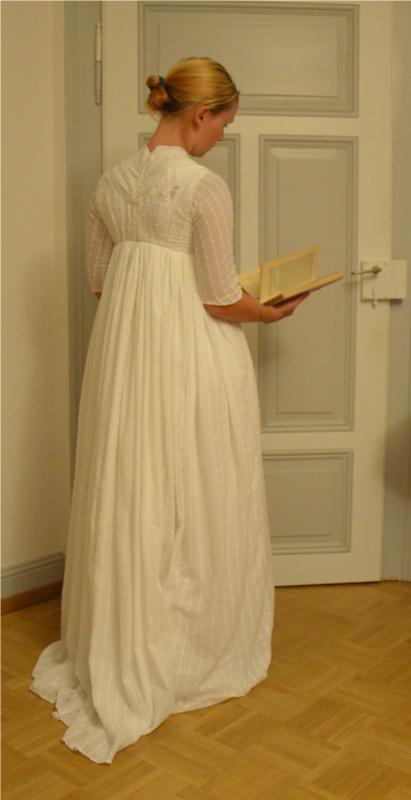
Danish Chemise dress 1790s - Danish National Museum


I've finally finished my "Danish Dress". It's about 99% handsewn, which is a first for me. :) And I like it SOOOO much. I love the way it is drafted and assembled, I am absolutely awstruck and I think the seamstress that made the dress was ingenious.


The Original dress: (more picture of my version futher below...)

http://natmus.dk/historisk-viden/temaer/modens-historie/1790-1840/hvid-brudekjole/

I had seen this lovely dress quite a while ago and wanted to make it. I had a bit of black voile left, so I considered remaking it in black.  if you want to know more about Chemise Gowns in black hop over to Festive Attyre http://www.festiveattyre.com/search/label/chemise%20gown)

Anyway, as you can see from the pictures, I didn't choose black fabric, because whilst searching for that, I stumbled across Matilda ... a lovely fabric from our favourite Swedish furniture shop. Matilda is a very sheer cotton curtain  (yes!!) with white stripes with bobbles woven into the fabric. I love it.

The dress is from the Danish National Museum in Kopenhagen.
http://natmus.dk/historisk-viden/temaer/modens-historie/1790-1840/hvid-brudekjole/
They even deliver the free pattern (taken from the actual dress, like e.g. Janet Arnold PoF)
http://natmus.dk/fileadmin/user_upload/natmus/historisk-viden/modens-historie/snitmoenster/hvid-brudekjole.pdf

The Museum dates it to "ca. 1797", but as they seem to know that it was Eleonora Sophie Baroness Rantzau's wedding dress and she married 1796, I suppose the date should be "ca 1796".

When I made the Mock-up, I found, that I could wear the pattern without many alterations. Just the sleeves needed slight adjustment and the length of the skirt. I felt a certain connection and wanted to know more about the lady, who wore this for her wedding. Also, I was brought up in Northern Germany, only 45min away from the Danish border and 3 hours from Kopenhagen. And my great grandfather is Danish. 

This is Eleonora Sophie Baronesse Rantzau:
http://finnholbek.dk/genealogy/showmedia.php?mediaID=269&medialinkID=570

She was born on the 24th August 1779 in Fjellebro Gods, that is on the island Odense (in Denmark, of course).  She was the second of 3 children, she had an older brother and a younger sister. When she was 16 (1st July 1796), she married Preben I. lensgreve Bille-Brahe (who 22 years old at the time). They had 2 children, Henrik lensgreve Bille-Brahe, (b. 21 Jan 1798) and  Frederik (Fritz) Siegfred baron Bille-Brahe (b. 26 Feb 1799). Her children were named after her father in law (Henrik) and possibly her father (Friederich Siegfried).
Only about a year after the birth of her second son, Eleonora died on the 21st of August 1800 aged 20 (that's only 3 days before her 21st birthday in fact, and also our wedding day, which is a bit creepy, but well, life's full of weird coincidences...). I couldn't find out the reason for her early death. I could imagine childbirth or pneumonia.
Her husband married again - 16 years later, a lady called Johanne Caroline Vilhelmine Falbe. They called their first born daughter Eleonora Sophie. Isn't that romantic? This is a picture of the couple a year after they married.

http://finnholbek.dk/genealogy/showmedia.php?mediaID=2346&medialinkID=25470

She died in 1823, and a year later he married another lady called Birgitte (Betzy) Susanne Sybilla komtesse Schaffalitzky de Muckadell  (b 1801) (wow, that name rocks!). But enough genealogy, if you are so madly interested, follow the links below for further information, because that's were I've got it from (including pictures)

http://finnholbek.dk/genealogy/family.php?familyID=F4376&tree=2
http://finnholbek.dk/genealogy/getperson.php?personID=I8847&tree=2
http://skeel.info/getperson.php?personID=I4890&tree=ks (look for Person ID I4890)
A little on the actual dressmaking:

The assembly of the dress is relatively straight forward, a big "thank you" to Mariell from https://www.facebook.com/Geschichtsgewaender// for her help with the translation of the Danish Annotations... the most important one is "the drawings are not too accurate, sometimes there is up to 2 mm difference and maybe more" or something like that. I have written a short tutorial here http://hertzwerk-freiburg.blogspot.de/2015/09/danish-dress-tutorial.html

I am wearing a white bodiced petticoat (La Mode Bagatelle) under the dress, which for me replaces the stays. I suppose to do it properly I should make a pair of transitional stays but that's another future project. Unfortunately the straps of the bodiced petticoat show through the sheer fabric (which reminds me: I should have made a lining, like in the original... never try to be more intelligent that an 18th century seamstress.... at least not this one, the dress was made in a extremely ingenious way). (If I make the dress again, I would line the fabric... or maybe I take the sleeves off and line them... or so...)

Finally, pictures!!


back view, with a very bad hair day and stupid straps destroying the wonderful inwards setting of the sleeves. :( The sleeves are very beautiful and I think I will use the pattern for more 18th century sleeves in the future. They don't need darts yet fit comfortable (hence the wrinkles under the arms...))


Love letters (The one from Guy the Maupassant was great, albeit being anachronistic!)

I am poking my nose up other people's love letters.

This is dedicated to https://www.pinterest.com/festiveattyre/regency-ladies-wedgie-society/


I also want to tell you a little story about the book I am holding in the pictures. It is a wonderful book called "Briefe der Liebe" (Letters of love), edited by Camill Hoffmann https://de.wikipedia.org/wiki/Camill_Hoffmann and some more about him here (in German language) http://www.radio.cz/de/rubrik/kultur/camill-hoffmann-botschafter-zweier-kulturen
The book was given by my great-grand-father to his then-fiancée for their engagement. This took place at Christmas 1912 (he wrote the date at the beginning of the book). It is love letters from the early 1700s to the late 1800s. And the choice of letters is wonderful. But here the romantic parts ends. Camill Hoffmann was killed in Auschwitz in 1944 together with his wife Irma. Life is bittersweet. If you can read German, try to get your hands on a copy. Or recreate the Danish Dress. Or both.


Have a great evening!

Hertzwerk X

Sunday, 7 September 2014

1790s jacket from IMATEX


My latest project is this 1790s jacket inspired by a 1790s jacket from the Imatex (Centre de Documentació i Museu tèxtil) here:
you can access lots of stuff there, if you want to look at the 1790s jacket, go to advanced search, then search for Register number 11551, then go to "full record" and voilà you can see pictures and read a despription in Catalan. I don't really understand catalan, but I think it's a children's jacket (they say) and the pictures do explain the rest. I call it the "Imatex jacket" (for obvious reasons).
What threw me a bit was, that I couldn't find many fashion plates depicting similar jackets. The ones that could be called similar were from fashion plates in the 1780s, but I suppose that doesn't mean much.
The following 3 pictures show the original jacket from the IMATEX collection.

original Imatex 1790s jacket

original Imatex 1790s jacket

original Imatex 1790s jacket.

This is the view of my pattern:
I've used the JPR Anglaise pattern as a start and then worked away on it. The sleeves are from Wingeo 207, but again, altered quite a bit (as I am NOT a giant). 


and these are the fabrics
silk repp in light cream with dots, silk damask in light blue/beige, ivory silk taffeta (for lining). Soutache apricot (not pictured) :)

I've used peach coloures soutache (2,5mm wide), about 12 metres. At first I was really sceptic about it, but I've used a colour scheme thingy on the internet called Paletton and determined the complementary colour to my blue-grey-brown silk was, in fact, peach. Wow, they did know what they were doing abck then. :)
So I dived in head first and attached the soutache. I am NOT a peach person... really. But I like the result. ;)
My biggest problem (apart from sleeves, right and left, buttonsholes patience and stuff like that) was to get fabric for the sleeve buttons matching the soutache - apricot  IS A NIGHTMARE! I did manage after months of repetitive visits to the fabric store (selfless...). :)

 And here are  pictures of the result:


 I am planning to make a matching hat like this for it, but have not got the materials for it yet (apart from the feathers and the black ribbon...)


Monday, 27 January 2014

1740s Ensemble inspired by Liotard's "la belle chocolatiere" 1743-5

Finally I have come up with my version of "La belle chocolatiere" by Liotard. Although I've made the mock-up a while ago it always takes me ages to get going on the real thing. I'm just so worried to cut the nice silk!!!! :) Anyway, I've done it now. A bit further below you find the inspirational picture, a real beauty. As I've not had the chance to see the original painting, I had to make a lot of guesswork concerning the colour. Also, of course, the pattern is really just inspired by this, I have absolutely no idea, whether the back folds are really made this way. I also have decided against front lacing. I am quite sure that in the picture the jacket is lacing in the front and also isn't quite closed (which might explain the odd fichu - apron situation). My jacket is front closing with needles. I am wearing the skirt over a bum pad, the bonnet is made from linen.


the chocolatiere also needs recreational time... please ALSO note the adoring daisy decoration in monsieurs side curls. ;)


La belle chocolatiere, Liotard, 1743-45


La belle chocolatiere, Liotard, 1743-45, detail


I do admit these pictures on the dressform aren't really doing the ensemble justice, but I am hoping to get some proper pictures of it at some point soon (more springish... we've just had a snow-rain-something shower...). Also the colours of my dress are really different,   darker... but well... are they ever what they seem, colours on photos and on the internet??? Anyway, I've also just taken side views, like in the portrait. 

with fabric giving the impression of the bib like in the painting

just an apron

jacket and skirt


detail collar

The plain bonnet in thin white linen is made following this pattern from Durantextiles


Thursday, 19 December 2013

1780/90s Blue Zone Gown


Journal des Luxus und der Moden March 1793 >KLICK!!<


Above, from the 3/1793 issue of the "Journal des Luxus und der Moden" - pp. 163
"[...] 2) Aus Teutschland
vom Rhein, den 20. Febr. 1793.
hier folgen einige Bemerkungen, die ich unterm Gewuehle und Getuemmel der Kriegsheere, das sich taeglich bey uns vermehrt, ueber die neuen Geschenke der Goettin Mode, die darum nicht aussen bleiben, habe machen koennen. 
Zuerst eine Figur von der jetzigen ganz artigen Tracht unserer jungen Frauenzimmer (Taf. 7.). Ein blaues Kleid von einem seidenen FruehjahrsZeuche, weißgefuettert; Rock und Kleid uni, ohne alle Garnirung; das Corset weiß; ein weißes Halstuch von Linon und den Kopf nicht so franzoesisch hineingepackt, als wenn sich der schoene jugendliche Hals, wegen eines haeßlichen Kropfes wegen, nicht duerfte sehen lassen. Das Haar in natuerlichen Locken, nur halb gepudert, und drauf eine Art von Carcasse von Band, die aus 5 Ribben von blau und weißem Bande besteht, zwischen welchen die lockigt-frisirten Haare allenthalben durchgucken.Ueberhaupt werden Huete anjezt blos zum aeussersten Morgen-Negligee zum Anzuge aber gar nicht mehr, und zu diesem blos von jungen Personen solche Band-Carcassen, von aelteren Damen aber kleine sehr schmale Haeubchen getragen. Dieß muß ich Ihnen als etwas Neues berichten. [...]"


So,

My previous research has led me to the conclusion for my interpretation of the zone-gown

1. It's to be worn over a "corset"
2. The back of the Gown will have 4 back panels and extra shoulder straps, Front A shape.
3. The skirt will most likely not be lined as it was rather unusual (unless i happen to find something suitable in my fabric stash).
4. worn over bum pad, no train.
5. fabric is blue, greenish iridescent silk taffeta.
6. petticoat slightly shorter for practical reasons.

With A shaped stomacher (bottom line unfinished)


ad 1
The corset is the base of the thus recycled "kitsch corset" (that I never wore, twas a good exercise in attaching bias tape though... ... ...) so really it is a version of the Period Impressions half boned stays. I have removed most of the bones and just left a few in the front and around the back lacing. I also made small changes to the front and removed the taps. Then I added two layers of ivory silk taffeta. Just one layer looked a bit thin and flimsy. I also made a A shaped stomacher, just to have another option. The Stomacher still needs a bit of shortening, but I think the general idea is clear. ;) 


ad 2
I have based the bodice on the JPR Anglaise, that fitted quite well. I then changed the front to have the A shaped gap (about 1,5" at the top and just above the highest point of the hip bones at the sides (spina iliaca anterior superior)). The front in the picture seems to be nearly at the back. I am not sure about how far back it acutally went, but I didn't want it to be too far back so I settled for hip bone. Maybe the picture sort of shows front and side at the same time for illustration (who knows...), a bit of early cubism. ;)
I made a mock-up and then changed the back panels and shoulder strap and I actually made 4 real pieces in the back (not a fake 4-pieces-back as I had initially planned). I took the Anglaise pcitured below as an example but made slight changes. As those changes moved the sleeves in a bit, I had to change the sleeve pattern accordingly (and i HATE setting sleeves in!!! Sleeves are my pet hate in sewing, I find I always have to make changes to make them look the way I want and it takes AGES!). I prefer 3/4 length sleeves to long sleeves and so I didn't extend them. Also I planned to make the bottom of the bodice back not arrow but box shaped. Unfortunately I completely forgot about altering the skirt part fabric to match so I ended up making a triangular shape. Attaching those folds neatly to the bodice was really getting to me, I needed 3 tries and due to the nature of the tafetta I had to stop and be content with the way the back pleats of the skirt are now. I have certainly learned for the next Anlaise! ;)
I initially  had planned to make another skirt for some change (in ivory, like the Corset/stomacher) but when I pinned it to the dummy to get an idea what it would look like, i really didn't like it. the white A-Shapw with white skirt underneath the turquoise just looked boring and bland. So I decided in just making on skirt in turquoise. The skirt is a bit shorter than the one on the fashion plate, for practicality.Also I had to piece the skirt back, as I ran 20cms short... you can't see it anyway, I pieced it with some black tafetta. ;) 


MetMuseum Anglaise

And I am admitting: These fabrics have been maturing in my fabric stash for more than 2 (nearly 3!!) years!!!


And that Hat is STILL absolutely mental. In the picture below her nice earrings are visible, though. A hook with a plate and something in the middle (possibly a gemstone). It's always good to know what was available back then. ;)


I'm not making it, because it reminds me of this christmas nightmare below. And I have the suspicion those bands on bands will just look like a big wobbly pouf. A "Carcasse" hat, ... REALLY!!

from amazon.


Wednesday, 13 November 2013

1750s Riding Habit - Janet Arnold

Let's say it's my "i'm mysterious" look. ;)


After receiving the program for the La Motte Tilly Weekend and reading the words "Hunt" "outdoor games" "Park" I was determined to whip together Janet Arnold's Riding habit (dated 1730s-50s). Luckily, the lovely Mme du Jard had copied and made the pattern previously so I could use her pattern and jacket for fitting purposes and didn't have to scale it up. :) Being a comparable size I didn't need to make many adjustments (again, lucky me...) and have come up with my version of the Riding habit. The original garment can be seen in the snowshill collection HERE.
I've started a collection of pictures of Riding habits in Pinterest, too, just in case: HERE.

I have used very dark blue loden cloth for both the jacket and the skirt (which is worn over small side hoops, rocking horse pattern, and a quilted petticoat). The pockets (which are fully funktional in the original) are just fake. 1. I would only use the hoops 2. I was running out of time. :) I didn't miss them a bit.
 I am also wearing a habit shirt, made from fine white linen, and white cotton scarf (thank you M. Beyschlag!). Out of reasons beyond my control (bad hair day...) I am not wearing a hat, which is nearly inexcusable. Concentrate on the green stockings instead.


green stockings! hunter's green maybe? So in no need of a rifle myself. ;)

here you can see another example of a riding habit with vest. and myself. and a very fine man with his rifle.

Snowshill Collection, Janet Arnold Pattern


Hoping to get some more pictures, too... :)