Showing posts with label analysing. Show all posts

Monday, 27 January 2014

Analysing - robe a la turque- 1780s

While searching for pictures of theAnglaise gown with the a-shaped front ("Zone Gown") I have been stumbling across 2 kinds of dresses: The "Robe a la Turque" and the "Robe a la Circassienne". In this post I am going to have a closer look at a few fashion plates (also see the Pinterest folder for reference and more pictures).

As far as I understand, the Robe a la Turque has been described in fashion plates in the mid- to end-1780s. I've found one example from 1780. It seems basically to be an overdress with short sleeves, worn over a long sleeved top of some sort. In some fashion plates it looks rather fitted, in other rather loose, like a light overgown. Mysterious!

 Robe of green and grey (or violet? or black?) over yellow top.

Cabinet des Modes, Novembre 1786 robe a la turque

 Red Robe over white top with yellow front lacing.

Robe a la turque - Magasin des Modes, Janvier 1788

rose Robe ober white top with cuffs in same rose colour
Robe a la turque - Cabinet des Modes, Juin 1786
Robe a la Turque - Magasin des Modes, Juillet 1788
"La jeune Eglé pleurant l'absence de son amant: elle est habillée d'une robe à la Turque avec des manches de gaze qui sont retroussées par des rubans, elle est coeffée en cheveux au coquelicot", Gallerie des Modes, 1786; MFA 44.1648

This one has the skirt cut extra!!
Robe a la Turque Magasin des Modes, Juillet 1787

Here comes some confusion about Turque or Circassienne, just to show that maybe it's not as strictly divided as we might think. I like to think of it as a Robe a la Turque, though:
 The 3 following fashion plates seem to belong together.
"Robe à la Turque ou espèce de Circassienne, mais différa.te des autres; elle a un collet comme une robe en Lévite, et une très grande écharpe blanche nouée à la ceinture; le juppon coupé; aucune garniture. Cette robe dont nous donnerons le développement de profil et par derriere, attira tous les yeux du Public, lorsquelle parut pour la premiere fois au Palais Royal, au mois de juillet dernier 1779", Gallerie des Modes, 1779; MFA 44.1436
What seems to be the typical back view of a Robe a la Turque: Bodice and Skirt in one piece with inverted pleats opening to give fullness.
1780 French Fashion Plate - Style: Robe a la Turque

"Robe à la Turque, la même expliqué au vingt septieme Cahier No. 159, elle est ici dévelopé de Profil ou Trois-quart", Gallerie des Modes, 1780; MFA 44.1466

 This one is a bit puzzling... it doesn't seem to be open in the front, yet it is called "a la turque" ?!
"L'aimable Constance tenant en lesse un Chien-Lion et rêvant à celui que son coeur aime: sa robe est à la Turque et son chapeau à la Mongolfier, pose sure une baigneuse, et ceint d'un ruban attaché d'une boucle à l'Angloise avec un panache", Gallerie des Modes, 1784; MFA 44.1587

Also some artists pictured the robe a la turque:
This might be a robe a la turque worn over very wide sleeves. But as we haven't got the front view... who knows...
Charlotte, Lady Milnes, 1788-1792 Robe a La Turque
 Just nice! Looks quite like the RObe a la TUrque. Short sleeves, worn over another dress, rather loose.
Marie-Louise-Elisabeth Vigée-Lebrun (French artist, 1755-1842)  Louise Marie Adelaide de Bourbon in a robe a la turque 1789

And finally here, an original Gown! Awfully like those 3 fashion plates from 1780, isn't it?!

Robe a la turque, ca. 1789; Nordiska museet NMA.0052362


Soon, I shall be posting a few observation about the Robe a la Circassienne.

You know something more about the Robe a la Turque? Tell me!


Tuesday, 21 January 2014

Analysing - 18th century muffs

I have given making another 18th century accessoire some thought. A muff.
A while ago I have seen this tutorial by Kathrine http://koshka-the-cat.blogspot.de/2013/01/an-18th-century-muff-cover-tutorial.html and thought it was a rather simple task. Unfortunately she doesn't give any reference as to the suitable decade. To cut a long story short, this sort of smallish muff works for the whole century, which might account for the fact that she didn't refer to a certain decade. If you want to look at a few more pictures, I have collected some muff-picture on may Pinterest - 18th Accessoires

 Muffs in the 18th century seem to be smallish (rather earlier) to medium (always suitable) size. Towards the end of the 1780s and the 1790s muffs tend to grow up to ridiculous measurements. But also medium sized ones can be seen on fashion plates. What seems to always work is a smallish-medium sized fur coated muff.

Here are a few examples:

1740s
Jean Baptiste Massé (French, 1687–1767), 'The Blue Muff' c 1740
1750s

1755. Louise Henriette de Bourbon.
French 18th Century Young Woman with a Muff, c. 1750 Chester Dale Collection 1943.7.5
1760s

Portrait of Madame de Pompadour with a Fur Muff - François-Hubert Drouais, 1763-1764 - The Athenaeum
Catherine Havers, attr. Barthélemy du Pan, ca. 1765; LMG LEEAG.PA.1966.0002.0002


1770s

Galerie des Modes, 11e Cahier, 2e Figure Middle class woman in a striped Satin Gown with a furred pelisse and a white muff. (1778)


Miss Lovejoy, 1772.
Winter by Collett Satire: a woman and her daughter wearing fur coats and muffs walking in a street with snow; behind them fighting school boys and a boy carrying a toboggan. c.1778/9 Hand-coloured mezzotint


1780s
Muff. English, 1785–1800. Silk satin, mezzotint on fabric, silk embroidery, pearls, gauze appliques, and silk plain-weave lining - in the Museum of Fine Arts Boston.

Mrs. Wilbraham Bootle, 1781 by George Romney, oil on Canvas, (c) National Gallery of Scotland, Edinburgh, Scotland.
Dress of the Year 1781, by Ann Frankland Lewis.
Striped dress ensemble with large striped fur muff - Magasin des Modes - March 1789 .- I LOVE that outfit, actually. :)
1790s

Gallery of Fashion, January 1796.

Gallery of Fashion, March 1798.

I recommend the above mentionned tutorial by Katherine. :)  Some time soon I shall post my own version. See you!

Wednesday, 23 October 2013

Anna Maria Garthwaite (1688-1763) - 18th century textile designer

When it comes to choosing fabric for a dress project I am rather reluctant to take risks. Which  means I mostly opt for plain colours as I found you can go SO wrong with a pattern... I mean, you can't take ANY plaid or striped or colour combination, and coming to even more complicated things like floral patterns the possibilities for choosing the wrong kind of style and colour become even more abundant.

Anyway, I have been stumbling across some fabulous pictures of this English designer from the 18th century and wanted to share it with you.

Garthwaite 1726-28, HOW MODERN IS THIS!!!

Garthwaite 1752

Garthwaite 1726, one of my favourites

Garthwaite 1728


Garthwaite 1751

Garthwaite 1734

Garthwaite at the V&A, search

(above pictures are from V&A)

Pinterest Board Garthwaite

About Anna Maria Garthwaite (from Wikipedia)

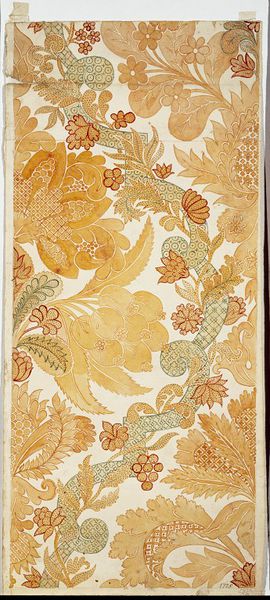
Anna Maria Garthwaite (born 14 March 1688 in Leicestershire– October 1763, Spitalfields ) was a textile designer and created beautiful and intriguing floral designs for Spitalfield Silks (damask and brocades). Mainly from the 1720s to 50s. Many of her watercolour and fabric designs (more than 1000!) have survived (see V&A collection), but also pictures of her designs and original garments. (follow the wikipedia link above for more information on her biography)

What I found most astonishing was how incredibly modern some of her graphical work seems. The little trees (first picture above) could have been designed just recently but no, she came up with it about 300 years ago! 300 years!!! The below pictures show a few dresses with designs that are really bold , nearly greometrical patterns. I didn't believe my eyes! She turned from these very stylized designs to more "true to nature" designs which came into fashion in England (picture at the very bottom), while French designers went more stylized.

Mrs Charles Willing of Philadelphia was painted by Robert Feke in 1746 wearing a gown of English silk damask woven to a surviving 1743 design by Anna Maria Garthwaite. ( from wikipedia)


Robe à l’anglaise
Red silk damask
Circa 1775, England
Fabric by Anna Maria Garthwaite, 1751 from:
http://www3.fitnyc.edu/museum/Arbitersofstyle/18thc.dress.htm
 

1740-1750 (woven) 1750-1760 (made) (attributed)  http://collections.vam.ac.uk/item/O85965/banyan-garthwaite-anna-maria/

http://www.mfa.org/collections/object/wedding-dress-worn-by-ruth-eliot-at-her-marriage-to-jeremy-belknap-49492 from after 1751

http://collections.vam.ac.uk/item/O361528/sack-back-gown-anna-maria-garthwaite/ 1752


More about patterns and do's and don't's here: Marquise Stoffmuster


Sunday, 29 September 2013

Analysing - La Belle Chocolatiere

I guess everybody has seen the lovely "La Belle Chocolatiere" by Liotard (1743-45). And I have also arrived at the conclusion, that I NEED a chocolatiere-dress.

Liotard, La Belle Chocolatiere (1743-5)

She's wearing a iridiscent skirt, from all I could tell from Internet pictures (I wish I could see the Original painting in Dresden!). Grey, blueish? Maybe a hint of green?
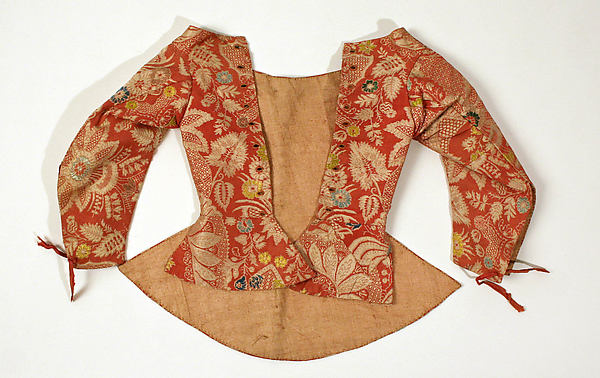
Her jacket is most intruiging. A  beautiful orange, brown, red. Not only that only a small part of it is visible, that bit is SO cute! Rather tight sleeves with beautiful winged cuffs. The back/tail of the jacket falls in beautiful fold like little waterfall and is lined with white fabric. It is cut shorter in the front that in the back.
I have also noticed a very small sort of wavy collar.
and now the most intriguing: at the top of the jacket between fichu and the jacket is a bit of yellow patterned "something". Are those her stays? Or is that some sort of very wide stomacher? Is the jacket fastening in the front over a stomacher anyway? It seems that between fichu and jacket underneath the apron top there is a dark gap that can't really be explained if you postulate a straight front fastening jacket. Or is the jacket fastening with laces in the fronst and not closed properly? Unlikely, she seems to be very tidy and neatly dressed... (light coloured shoes and that light rose cap!)

I have really no idea, what the front of the Jacket looks like, but it's definitely a looker. ;)


This is what I found in online collections... not too close to that, but not too far off, either. 

Metmuseum 1725-30s, is this the back or the front? sleeves look a bit funny to be the front...

Nationaltrust UK 1736-40


Sunday, 22 September 2013

Analysing - Zone Gown 1780/90s

For my project of the blue Zone Gown (inspired by a fashion plate from the "Journal des Luxus und der Moden" from March 1793) I have started a little investigation on Zone Gowns. 

I've not found it particulary easy to find evidence and examples, but here's my conclusion which shall lead me to my result. :) Those who speak german might wish to have a look at the original article of my inspiration gown from the Journal des Luxus und der Moden, accessible at the Uni Jena (Link on my link page). The headwear is a ribbon carcasse thingy, I've not quite worked out how that works and chances are I never will, because - I don't like it. The hair falls rather loosely over the shoulders, that's worth noticing. The sleeves are long and tight, the skirt has a white lining (I found this rather unusual). White gloves, big fichu and an enormously big flower thingy (sorry, the right name for that escaped me), personally I find it absurdly big, it would certainly droop down, am going to omit that too...

Journal des Luxus und der Moden March 1793, with short description, worn over "corset"

A Zone Gown (which is the modern description for it, really we're talking about a Robe a l'Anglaise with an A Shaped cutout at the front, I can't quite remember, whether I've found a specific term for that in 18th century documents...)

This type of gown was made with a stomacher or just the illusion of an A-shaped stomacher and front closure or a corset underneath (a corset being a sort of sleeveless top). I've not found many existing gowns where I could see for sure how it's done, but these three options seem to be it. They seem to have been most popular by the mid/late 1780s and early 1790s. France a bit earlier, Germany a bit later.


KCI Museum, described with stomacher, this is not a zone gown but a court gown, yet it has the A shaped front.

LACMA, front-closing, gorgous stripes, too!

a few more examples somewhere here: Hertzwerk Pinterest 18th century clothing

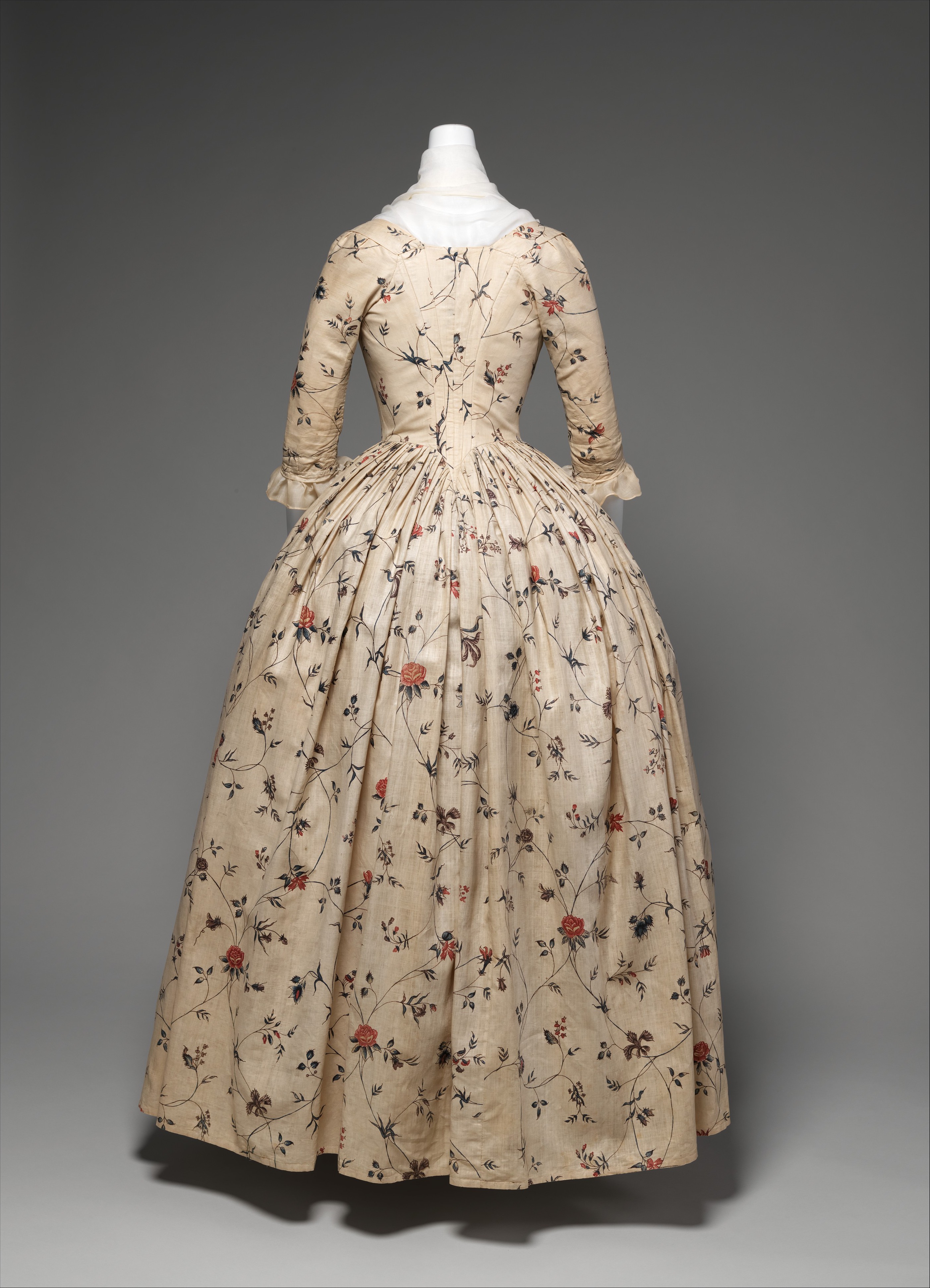
The back of the gown would have most likely looked like this, with 4 panels in the back. Although if you look at existing garments, the back can look all sorts of ways, more or less tidy, detailed, pieced... looking at Nancy Bradfield's Costume in Detail reveals that. So funnily, the more I research on how the back should look like, the more I found "anything goes". So be it.


MetMuseum 1785-95 - typical back of gown

As to sleeves... I've found them in all lengths and the direction of the stripes was apparently following the gusto of the wearer, also lengthwise stripes being possible (see LACMA Zone gown).

I will let all that information mature now see what I'll come up with.