Showing posts with label hat. Show all posts

Tuesday, 24 November 2015

A 1770s Dormeuse or the "Mrs Miggins Cap"

This enormous 1770s cap was lovingly nicknamed "the Mrs Miggins cap" by my husband. The name sort of stuck. :)


These pictures were my inspiration, but I changed and combined, as usual. I am just no good at exact reproductions. :)

https://www.pinterest.com/pin/325807354270921179/
https://www.pinterest.com/pin/325807354270921177/
https://www.pinterest.com/pin/325807354270921172/
https://www.pinterest.com/pin/325807354270921170/

more pictures of 18th century caps: https://www.pinterest.com/hertzwerk/18th-c-caps/

I used white or off white (I can't really tell...) silk organza (2,8), which is very thin and nice. Some of the ribbons/frills I treated with corn starch to stop them from fraying, because I didn't want to hem them to keep the whole cap "airy" despite its many decorations.  It doesn't totally stop fraying, but it helps a little to keep the fibres together.

I didn't use a pattern, but if you want to use a commercial pattern, the base of the cap is close to JP Ryans Dormeuse/Baigneuse. All in all I used nearly 2 metres of fabric.

(yes, the wig is hilarious, I've written a tutorial about it...) :)  http://hertzwerk-freiburg.blogspot.de/2015/10/1770s-big-hair-wig-tutorial.html

Friday, 11 September 2015

The "Duck à l'orange" Cloche

Another cloche in a colour that will definitely make car drivers see me in winter. :) For no real reason (other than the strikingly orange colour, obviously) it became the "Duck a l'orange" cloche.
This time I've planned the positions of the pleating a bit more careful, used stainless steel super fine needles and didn't brush as vigorously. :)


my skills considering hair-dos definitely need seeing to...


I still have a lot to learn about the free from felting but I think I am getting somewhere. Even the weather has changed - from nearly 40 degrees celsius to about 24 degrees. :) Autumn is definitely on its way!

Normally I wouldn't choose orange, but I do like the cloche, although I am not sure, whether orange really suits my complexion. Nevertheless, I guess in winter it will look nice with a  black coat. 

Friday, 14 August 2015

The Postillon Cloche


The past few days (well, over a week really, with several interruptions...) I've spent experimenting with free form felting. And I can only say: I love it. I found it a very sensual experience to work with the felt cones with all the steaming and manual shaping. It made me think about millinery and milliners in a completely different way. 
This friendly person is trying to present you her first felt hat creation. What you don't see is the totally enthusiastic 3 year old clinging to her left leg.

Anyway, some time (...ages...) ago I had bought a set of hat cones in light colours and I started by choosing the one with the colour I thought I'd wear least... in case it goes wrong you don't want to waste the really nice super colour. It was a bright yellow wool felt cone. Yellow happens to be the colour of the German Post. In the end I attached a wood button covered in very dark dark blue woolen fabric, and then I thought "this would go really well with the German Post work gear" and for a very short moment considered an alternative career. 
Despite the vigorous colour (that doesn't really suit me...) I really like the outcome for the first time felting. I learned a great deal of things about the directions of felting, about how the material behaves, ... and about needles. It is really annoying if your needles rust away while the hat is drying. As I had put it in the loft to dry, I didn't see what was happening right away so I unfortunately have a few rust stains that mark the ex-needle-holes. In a way I don't mind too much,  probably because the hat is ... yellow... although I guess it's great in winter on the bike - people will definitely see me... :) 
Talking about the weather - I can't answer the question why I made a wool felt cloche while the outside temperature was nearly 40 degrees Celsius. I also made a batch of dark chocolate macaron. 

40 degrees Celsius outside (nearly) - it WAS a little hot under that wooly cloche, I have to admit.


If you want to try free form felting, these are the things I learned this time
1. It is really good to thoroughly spray the hat with water the night before and keep it in an airtight plastic bag over night so it is nice and evenly moist. 
2. Hot water steam is still really hot.
3. Use needles that don't rust and that aren't too thick. 
4. Cover your hat block with cling film, it really helps cleaning up. 
5. When you brush your hat for the last finish, don't get carried away. I tried to remove a few of the rust stains by brushing the hell out of the felt with a suede brush, and while a few strokes really liven up the colour and texture, everything beyond "a few strokes" creates a fluffly sheep like surface. Unless you go for fluffy and sheeplike. It sure didn't help against the rust stains. :) 


 I wish you a lovely day. Enjoy! X


Tuesday, 19 May 2015

Some hats, some beans


Sooo,

after my hat stiffener experiment I had 4 hat bases. :) And let's not forget that first ever silk rose!

Below you see the hat bases with petersham ribbon attached and the betty hat with the bobbly has both bobble and comb attached, too. :)

 Diameter 13cm

Diameter 13 - 10 - 8 cm

Please do excuse me, I am not wearing make-up. I just didn't have the time... concentrate on the hats instead! ;)


I've combined the hat base with the silk rose and swirls of same felt.
 

I don't know why, but I find this a little "Parisian"... I LOVE it.

this hat HAS got a bobble hidden somewhere!

THERE is the bobble!


 I have attached a little bit of black veiling with self-made light beige dots to this one, it sort of reminds me of vintage hats with their lovely veils, but it is definitely a modern little thing.

with a bit of black veiling with light beige bobbles here.


 I am still working on the tiniest hat you can see above, it's going to get a tiny bobble, too, like a shrunk version of the above bobbly hat. I am also still working on the headpiece.

So long, have a lovely week!

PS: some of you might have recognized the "Blackadder II" quote of the title. https://www.youtube.com/watch?v=8Y0yolPv7tU

Friday, 8 May 2015

Marilyn's Dresses - "Misfits" headpiece

I've had a little bit of time to do things "DIY" (when not looking after the baby) and the first thing is an early 1960s headpiece, inspired by Marilyn Monroes headpiece from the film "The Misfits" (1961) (pictures further down).

Version 1

How come?


I've loved this picture ever since I saw it for the first time (which is a loooong time ago...). But only now I've come to the point where I started thinking about making the outfit myself. This year, starting with the headpiece.The dress and jacket are to come later in 2016.


As always, it is not as easy as it seems. My first thought was - that's just a bit of Chenille wire with a bit of bobble veiling. And then you start looking closer. (lots of pictures following) - and then I ended up watching the film. :) "The Misfits" on Youtube. :) https://www.youtube.com/watch?v=1lQ7xQfNMmc


1. the veiling: it's fine black veiling with different size bobbles - small at the top and slightly bigger at the bottom. That's a real problem. Modern veiling usually has bigger nets (this one seems quite delicate) and bigger (if not to say huge) bobbles/dots. And how on earth is it attached???

2. I was torn between thinking it was a melusine fascinator and chenille wire attached and thinking it was really just chenille wire. it looks SO NEAT!

Conclusion: 
From the pictures alone my question (hat or chenille wire) couldn't be answered, but watching the film (and the headpiece already appears in the first 15mins) did help (and it happens to be a good albeit slightly strange film) :) It is indeed a headpiece made from black (chenille?) wire, attached to the aforementioned veiling. In the back it has two little bows - she's wearing it over a french twist/bun hairdo. Beautifully simple and elegant!


My versions:

Nice black chenille wire is not a problem, I found it right away. But the veiling was a problem... you don't get netting as fine as the one on the picture and you also don't get fine netting with chenille dots like that...


I made a prototype first because I wasn't quite sure how that veiling was actually attached. I am still not sure, but I like it this way best. :) 


the prototype

After looing for modern veiling with suitable dots (not available) and vintage veiling with suitable dots (didn't find anything in black and with dots in exactly the right places and it's also ridiculously expensive) I decided to make my own chenille bobble veiling.

Version 1
I continued using the prototype and experimented with different size chenille wire. Yes, the ordinary one from the arts and crafts shop. It might not be as great as millinery chenille wire, BUT it is available and looks okay, too, I think. When I finished I noticed I had attached the bobbles the wrong way round... the fat ones need to be at the bottom... I do like this version a lot though, nearly better than Version 2.

bobbles wrong way round BUT at least I look friendly, don't I?


Version 2
I made a new frame, slightly bigger tulle bows at the back and fat bobbles at the top and the rows with the dots slightly different from both prototype and original ;) 


sorry, not as neatly attached as I would like it but I didn't have the time

Sorry there is no back view, I will try and add one later, the back looks pretty much like the original. black wire and two small bows. :)

The original:


all pictures from Pinterest. and here somewhere https://www.pinterest.com/hertzwerk/marilyn ) These pictures were taken 1960 in Reno and on the Set of "The Misfits". 

Film:
better back view. It's really just a wire.


Thursday, 23 April 2015

Getting into millinery - the materials

Because of the fitting issues connected with my post-pregnancy shape, I am getting into millinery this year. I've always wanted to do that anyway ... :)
(yes, I am pausing woolly things for now - what good is a warm scarf or poncho in July at 35 degrees Celsius?  - and I am planning to get into sewing again by the end of 2015/beginning 2016)

A word on millinery:
Millinery is a highly specialized trade. It's not something you just "do". It requires not only special equipment and material but also knowledge and skills. Something that you usually learn in years of an apprenticeship and refine all though your life.
I am hoping to acquire some skills in the future, but you never know what happens.
I am expecting this to be a long and hard ride with successes and setbacks, with good ideas that turn out completely horrible and mistakes that turn out wonderfully. I am hoping to be able to use these skills for my historical projects as well as vintage inspired headwear for "everyday" (1920s cloches, 1950s headpieces).This will include covered buckram frames as well as felt based hats.

Hatmaking/Millinery also includes making the decorations yourself - e.g. work with feathers or making silk flowers from scratch. I have to be honest - I'd LOVE to be able to make one of those hilariously big and beautiful silk peonies or silk roses, but I am not sure, whether I am ever going to get there. Especially the japanese flower making art seems so appealing...  Making something like this would be great, wouldn't it?

from an alaya bar ad, google, never mind the jewellry, look at the flowers!!


Anyway, back to millinery:

It all started with always wanting a properly fitting 1920s cloche. And never finding one. And then I stumbles across free-form hat blocking (see e.g. here, a video on youtube.com: https://www.youtube.com/watch?v=-Nj0bBbkBA8)

And then I found this book:

http://us.macmillan.com/books/9780312656867

I really like this book, the author gives an overview over materials first. What I REALLY appreciate was her suggestions to use an old fashioned waterkettle to generate steam. So far I had only found apologetic "yeah, these professional steamers are, like, really expensive, but what can you do..." (you can only get these apparently jiffy steamers (Germany)). And to  be completey honest with you, I didn't really think spending about 250 Euros just to do a bit of millinery on just a steamer was quite worth it.

I also got this one:
It is in German and it focusses on modern millinery, too, with reference to stuff available in Germany.
People don't wear headwear as much here, so it's more difficult to get things.

(picture form amazon.de)


So over the last months I have slowly started to collect the ingredients

An old fashioned water kettle.
You can't see it, but it is big. It can contain about 4 litres and the bottom circumference is about 22cms. I love the spout. I could even make tea in it. It is in perfect, spotless condition, looks as if it had never been used before. Or just really gently. It should produce lots of lovely steam. :)

(picture from ebay.de bidding)
And lots of bits and bobs

- sturdy needles (I got some that are meant for model plane making, they have a finger friendlich plastic top, "Stoßnadeln")
- for a start simple wool felt cones (I prefer the softer surface of melusine or peachbloom, but for practising simple ones should do) and plain 100% wool felt pieces
- millinery wire (Hutdraht)
- millinery needles (Modistennadeln)
- suede brush (Rauhlederbürste)
- felt stiffener (this proved to be the most difficult part, more on this in a later post) and brushes
- water spray bottle
- petersham ribbon (cotton/viscose blend) (Ripsband)
- and last but not least a hat block

- due to the need for experiments regarding felt stiffener I got a small fascinator hat block, so I could try out different stiffening techniques before ruining the felt cones.

(picture from etsy.com, easyhatblocks)


- For free form hat blocking a hat block like this is required, you can also use it for small headpieces, fascinators and wig-dressing. We'll see to that later. Due to the need to experiment with the stiffener first,

(picture from etsy.com, borsolino)

The hat blocks are the biggest investment if you want to get into millinery...

So long!

From http://www.alice-in-wonderland.net/alice2a.html


Coming up next in millinery: the felt stiffener project.

Wednesday, 18 February 2015

1806 - Cantab Hat

I am making my way into millinery (yes, another thing on the "what to do if you can't fit clothes"-list)...

Without any special reason I made the Cantab Hat (1806) by Lynn McMasters (http://lynnmcmasters.com/). It is apparently inspired by Napoleonic Polish Lancers and Cambridge Graduates' hats. (although I have to say I didn't find convincing pictures of either of them...). The pattern in this form is no longer available, they are split into 2 patterns - the Cantab Hat and the Regency bonnets.

So how did it turn out?

I started, as recommended, with a cardboard mock-up. And thank goodness I did, because it was HUGE!!  I could pull the whole hat with greatest ease over my ears and looked less than graceful. As I was still determined to make the hat I just had to adjust it, right. With all those curved lines, squares, circles.... right. It worked out ok in the end.
What doesn't help is, that I am not a particular fan of her instructions. I really love her work, but when it comes to explanations, my brain seems to work differently and it takes me ages to understand what she actually wants. And like with the Victorian hats, I ended up assembling the pieces in a different way anyway.

Basically, all I need from the pattern are the pieces themselves and the rest is learning by doing.  Although it is a bit sad if you have a package like that and you just feel like chucking out the instructions.

Anyway, here is the hat,
I have made it in black cotton velvet and added a bit of  white feather decoration. (this time excellent explanation with pictures on her homepage http://lynnmcmasters.com/Pompom.html .) I caused a giant mess with cutting the feathers though. I still feel a bit like a chicken. Or Ostrich. :)
The hatband and lining is black cotton voile (also attached in a slightly different way...). It should have been silk charmeuse, but I didn't have any. I've also added a few black ribbons so the feathers don't feel to alone.


the white pompom is not so easy to spot in front of the grey door... sry... I am also NOT sporting a 1806 hairdo... and I couldn't find any hat needles... so... imagination required! :)


I am really sorry I don't seem to be able to take good photographs... but I think it is clearly a hat. :)

edit 21.2.15:
I just HAD to do some more research on hats of this shape, as the pattern doesn't really give any sources or examples. This is what I found, it's not much, but then again it is SOMETHING and there might be more out there... It just sort of proves, that this sort of shape is possible. Although I would put the date rather later towards 1814 or so... but well...

1816: https://www.pinterest.com/pin/325807354268363181/ (not much of a brim and higher)
1816:  https://www.pinterest.com/pin/325807354268363177/  (no big brim and higher)
1813: https://www.pinterest.com/pin/325807354268363064/  (a lot higher BUT made from Velours/velvet)
1814: https://www.pinterest.com/pin/325807354268363105/ (this one has the best ressemblance, but made from straw) 
1806 https://www.pinterest.com/pin/325807354268363125/ (wider brim)
1801 https://www.pinterest.com/pin/325807354268223419/


Sunday, 5 October 2014

Oh help! Oh no! It's A Calash!


I am reading the Gruffalo a lot with our little daughter and when I came to writing this post about my latest project, I couldn't help thinking in those words.

Anyway. It was a rather spontaneous project which had the purpose of keeping my mind busy (for various reasons) and being inexpensive. So, I've been thinking about a calash for some time and had looked at some pictures, and now the time was ripe.
I've still had plenty of reed and some silks left over.
Calash (or Calèche) is a horse carriage, really. (read more here at Wikipeda e.g. )

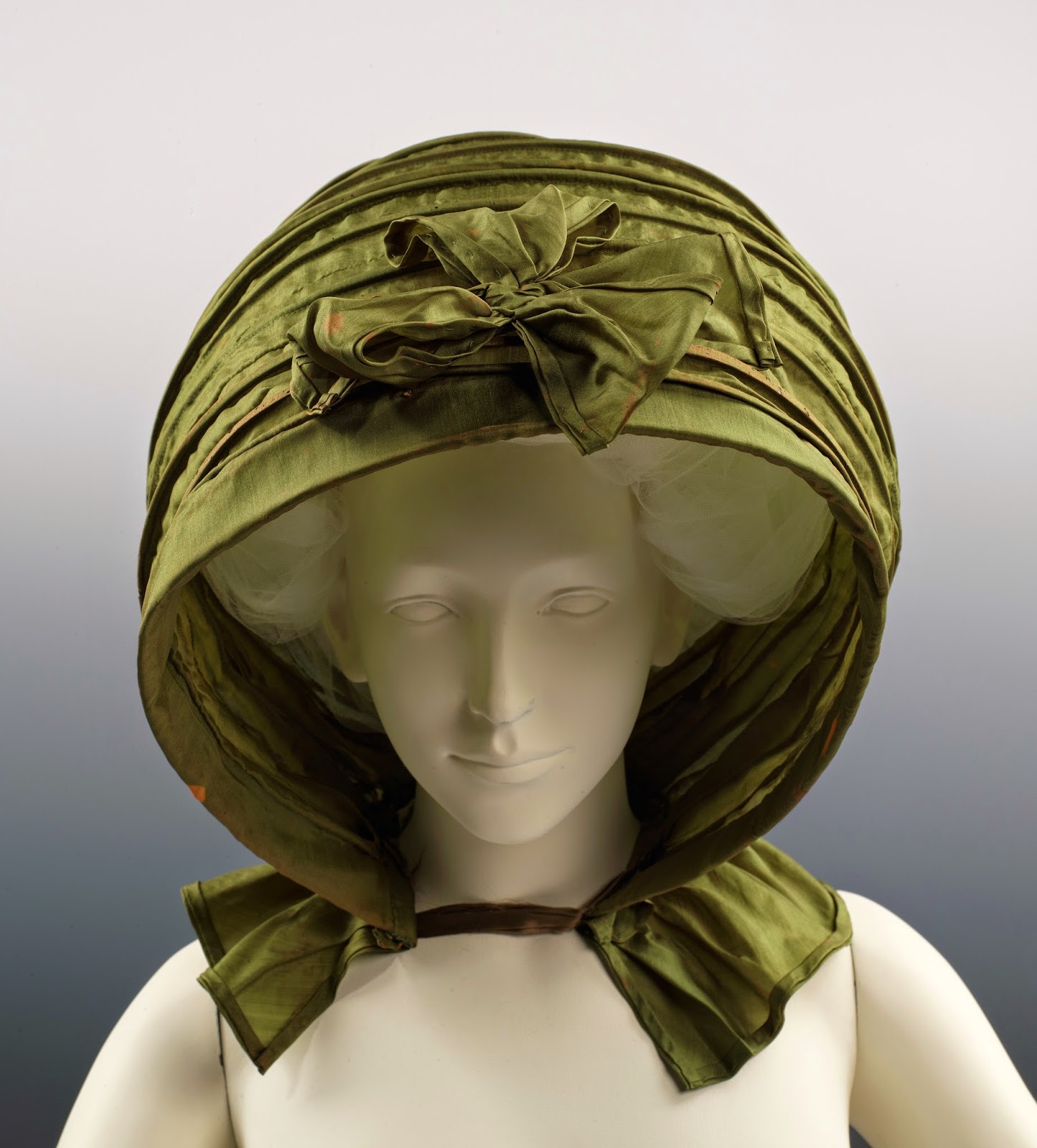
First a quick analyses of the calashes I used as examples. They can be found on the metmuseum.org homepage. Also refer to my pinterest board for more examples or this homepage, that has plenty of links to museums


http://www.metmuseum.org/collection/the-collection-online/search/116612?=&imgNo=0&tabName=related-objects


http://www.metmuseum.org/collection/the-collection-online/search/157763?img=1&imgNo=0&tabName=related-objects


If you follow the links you will find a few more photographs. The MetMuseum has some other Calashes from the 18th and early 19th century and also Pinterest is a good source for finding more pictures.

From those (and a few more, but let's not get overly into this) I have deducted the following things for my project:

1. The calash itself is based on a rectangle. The size of the rectangle is determined by the height and depth you want ot achieve. I noticed that in the above examples the boning seems to be "riding" on top of the calash. I assume, that first the lining is mounted to the outside fabric and then the tunnels are sewn through all layers. The reed probably has a distance of 2 inches. And in between there seems to be either a gathering stitch or an actual seem to allow that accordeon-like folding.

2. The back is either just the rest of the rectangle gathered and cut to fit into that sort of horse-shape OR it is a neatly cut flat extra piece of fabric and lining. Most calashes seem to have a ribbon in the back.

3. A ruffle (at least, could also extend to a "nearly-cape" length) was attached to the bottom of the calash and a ribbon in front to secure it and keep it in shape. Also seems to be a simple rectangle mostly.

4. Some calashes have (like the green one above) extra decoration (I love that extra bow on the green one!).

5. Although you don't see them on the pictures, I would think they had a small ribbon somewhere to pull them up agains the wind and over the head.

6. Both calashes have a sort of brim in the front, the green one has a rather straight one that might be padded with an extra layer of stiffer fabric, the violet one has some sort of double ruffle. Anyway, neither of them ends with a bone but with something decorative.

Personally I like the shape of the green one best, not very bulky and ruffly. So that's the shape I was trying to achieve.

13 boning chanels, 2 thereof in the back so slightly shorter. aprox. 2 inches apart?
in between fold to the inside, w/o boning.
2 bows.
supposedly flat back.
simple straight brim in front, possibly stiffened.
simple self fabric ties.

I've had particular fun with the reed I've used. It came in a round bundle and gave the whole thing the shape of an orange. But I wanted horse-shoe. My mock-up wasn't promising. So after doing some research into reed (which led me to most informative sited about basket making...) I've learned a lot of new stuff. Did it help the calash? Who knows.

So here we are, this is my version of a calash. Sorry, no big hair day... :) 


Also not a big smiley face day. Could be worse, though. 

my favourite view.


And for everyone who's made it this far: Here's an experimental pattern. It's not complete and will still take a bit of fiddling I'm afraid, but then I'm not a professional pattern person and it's free. ;) The pattern is in English. Sort of.

Calash Pattern.pdf

Enjoy your day!
(PS: No, it's not entirely handsewn, I've used the machine a fair bit, because I wasn't convinced it would turn out okay... shame on me... I would recommend sewing the boning channels on the outside by hand, though... if you want to do it half-properly... but well... next time...)

Saturday, 8 October 2011

free baby knot-hat pattern!!

Das hier hab ich im Netz gefunden und finde den Hut SO süß! Und damit alle dran teilhaben können, hier der Link!!

Stoff: An Apple a Day... von hamburgerliebe bei michas-stoffecke.de


I've found this free baby hat pattern on the internet and couldn't resist to share it with you. It's really simple and SO cute!!


free baby hat pattern and tutorial
the baby knot hat pattern pdf


Monday, 23 May 2011

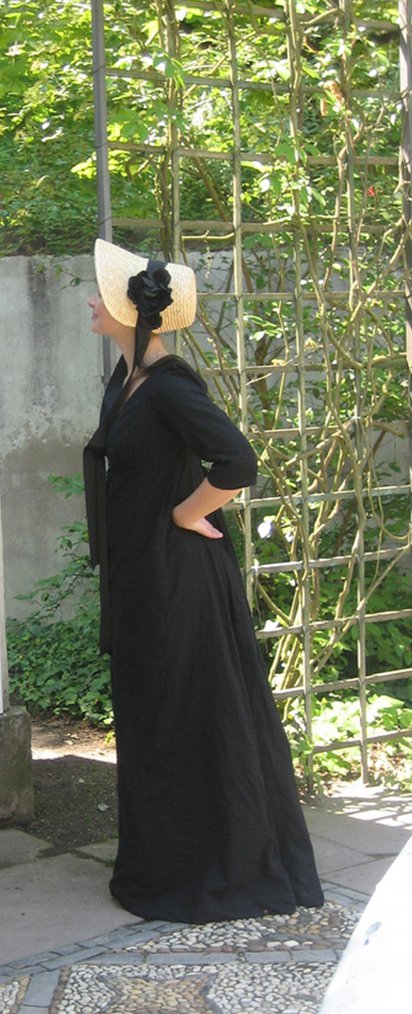
Regency Empire Ausflug Schwetzingen

Hier ist ein kleiner Eindruck von unserem Ausflug zum Schloß nach Schwetzingen. Der Park (PLAN) ist wunderschön und das Schloss natürlich ebenfalls, hier ist der Link für mehr Info: Schloss Schwetzingen

Das Wetter war ein Traum, warm, blauer Himmel mit einzelnen Wolken, manchmals eine leichte Brise.
Das Kleid ist entstand nach einem Schnitt von La Mode Bagatelle: Crossover bodice


vor dem Apollo Tempel


nanu?! Was seh' ich da?!?