Wednesday, 23 October 2013

Anna Maria Garthwaite (1688-1763) - 18th century textile designer

When it comes to choosing fabric for a dress project I am rather reluctant to take risks. Which  means I mostly opt for plain colours as I found you can go SO wrong with a pattern... I mean, you can't take ANY plaid or striped or colour combination, and coming to even more complicated things like floral patterns the possibilities for choosing the wrong kind of style and colour become even more abundant.

Anyway, I have been stumbling across some fabulous pictures of this English designer from the 18th century and wanted to share it with you.

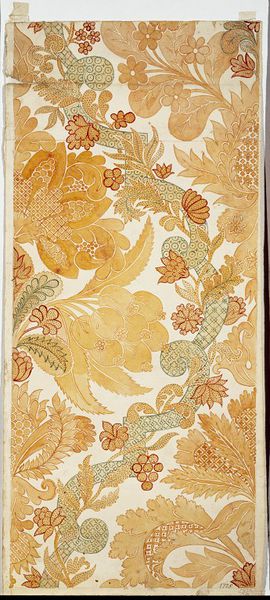
Garthwaite 1726-28, HOW MODERN IS THIS!!!

Garthwaite 1752

Garthwaite 1726, one of my favourites

Garthwaite 1728


Garthwaite 1751

Garthwaite 1734

Garthwaite at the V&A, search

(above pictures are from V&A)

Pinterest Board Garthwaite

About Anna Maria Garthwaite (from Wikipedia)

Anna Maria Garthwaite (born 14 March 1688 in Leicestershire– October 1763, Spitalfields ) was a textile designer and created beautiful and intriguing floral designs for Spitalfield Silks (damask and brocades). Mainly from the 1720s to 50s. Many of her watercolour and fabric designs (more than 1000!) have survived (see V&A collection), but also pictures of her designs and original garments. (follow the wikipedia link above for more information on her biography)

What I found most astonishing was how incredibly modern some of her graphical work seems. The little trees (first picture above) could have been designed just recently but no, she came up with it about 300 years ago! 300 years!!! The below pictures show a few dresses with designs that are really bold , nearly greometrical patterns. I didn't believe my eyes! She turned from these very stylized designs to more "true to nature" designs which came into fashion in England (picture at the very bottom), while French designers went more stylized.

Mrs Charles Willing of Philadelphia was painted by Robert Feke in 1746 wearing a gown of English silk damask woven to a surviving 1743 design by Anna Maria Garthwaite. ( from wikipedia)


Robe à l’anglaise
Red silk damask
Circa 1775, England
Fabric by Anna Maria Garthwaite, 1751 from:
http://www3.fitnyc.edu/museum/Arbitersofstyle/18thc.dress.htm
 

1740-1750 (woven) 1750-1760 (made) (attributed)  http://collections.vam.ac.uk/item/O85965/banyan-garthwaite-anna-maria/

http://www.mfa.org/collections/object/wedding-dress-worn-by-ruth-eliot-at-her-marriage-to-jeremy-belknap-49492 from after 1751

http://collections.vam.ac.uk/item/O361528/sack-back-gown-anna-maria-garthwaite/ 1752


More about patterns and do's and don't's here: Marquise Stoffmuster


Sunday, 29 September 2013

Analysing - La Belle Chocolatiere

I guess everybody has seen the lovely "La Belle Chocolatiere" by Liotard (1743-45). And I have also arrived at the conclusion, that I NEED a chocolatiere-dress.

Liotard, La Belle Chocolatiere (1743-5)

She's wearing a iridiscent skirt, from all I could tell from Internet pictures (I wish I could see the Original painting in Dresden!). Grey, blueish? Maybe a hint of green?
Her jacket is most intruiging. A  beautiful orange, brown, red. Not only that only a small part of it is visible, that bit is SO cute! Rather tight sleeves with beautiful winged cuffs. The back/tail of the jacket falls in beautiful fold like little waterfall and is lined with white fabric. It is cut shorter in the front that in the back.
I have also noticed a very small sort of wavy collar.
and now the most intriguing: at the top of the jacket between fichu and the jacket is a bit of yellow patterned "something". Are those her stays? Or is that some sort of very wide stomacher? Is the jacket fastening in the front over a stomacher anyway? It seems that between fichu and jacket underneath the apron top there is a dark gap that can't really be explained if you postulate a straight front fastening jacket. Or is the jacket fastening with laces in the fronst and not closed properly? Unlikely, she seems to be very tidy and neatly dressed... (light coloured shoes and that light rose cap!)

I have really no idea, what the front of the Jacket looks like, but it's definitely a looker. ;)


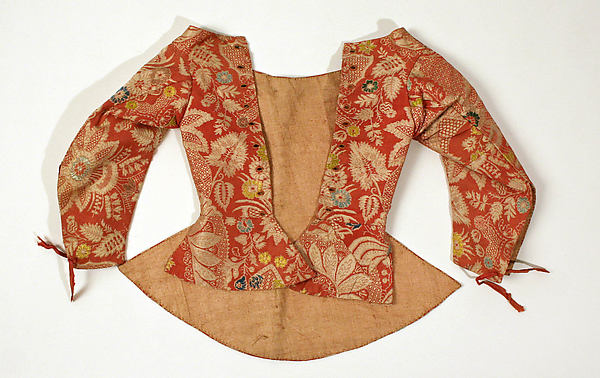
This is what I found in online collections... not too close to that, but not too far off, either. 

Metmuseum 1725-30s, is this the back or the front? sleeves look a bit funny to be the front...

Nationaltrust UK 1736-40


Sunday, 22 September 2013

Analysing - Zone Gown 1780/90s

For my project of the blue Zone Gown (inspired by a fashion plate from the "Journal des Luxus und der Moden" from March 1793) I have started a little investigation on Zone Gowns. 

I've not found it particulary easy to find evidence and examples, but here's my conclusion which shall lead me to my result. :) Those who speak german might wish to have a look at the original article of my inspiration gown from the Journal des Luxus und der Moden, accessible at the Uni Jena (Link on my link page). The headwear is a ribbon carcasse thingy, I've not quite worked out how that works and chances are I never will, because - I don't like it. The hair falls rather loosely over the shoulders, that's worth noticing. The sleeves are long and tight, the skirt has a white lining (I found this rather unusual). White gloves, big fichu and an enormously big flower thingy (sorry, the right name for that escaped me), personally I find it absurdly big, it would certainly droop down, am going to omit that too...

Journal des Luxus und der Moden March 1793, with short description, worn over "corset"

A Zone Gown (which is the modern description for it, really we're talking about a Robe a l'Anglaise with an A Shaped cutout at the front, I can't quite remember, whether I've found a specific term for that in 18th century documents...)

This type of gown was made with a stomacher or just the illusion of an A-shaped stomacher and front closure or a corset underneath (a corset being a sort of sleeveless top). I've not found many existing gowns where I could see for sure how it's done, but these three options seem to be it. They seem to have been most popular by the mid/late 1780s and early 1790s. France a bit earlier, Germany a bit later.


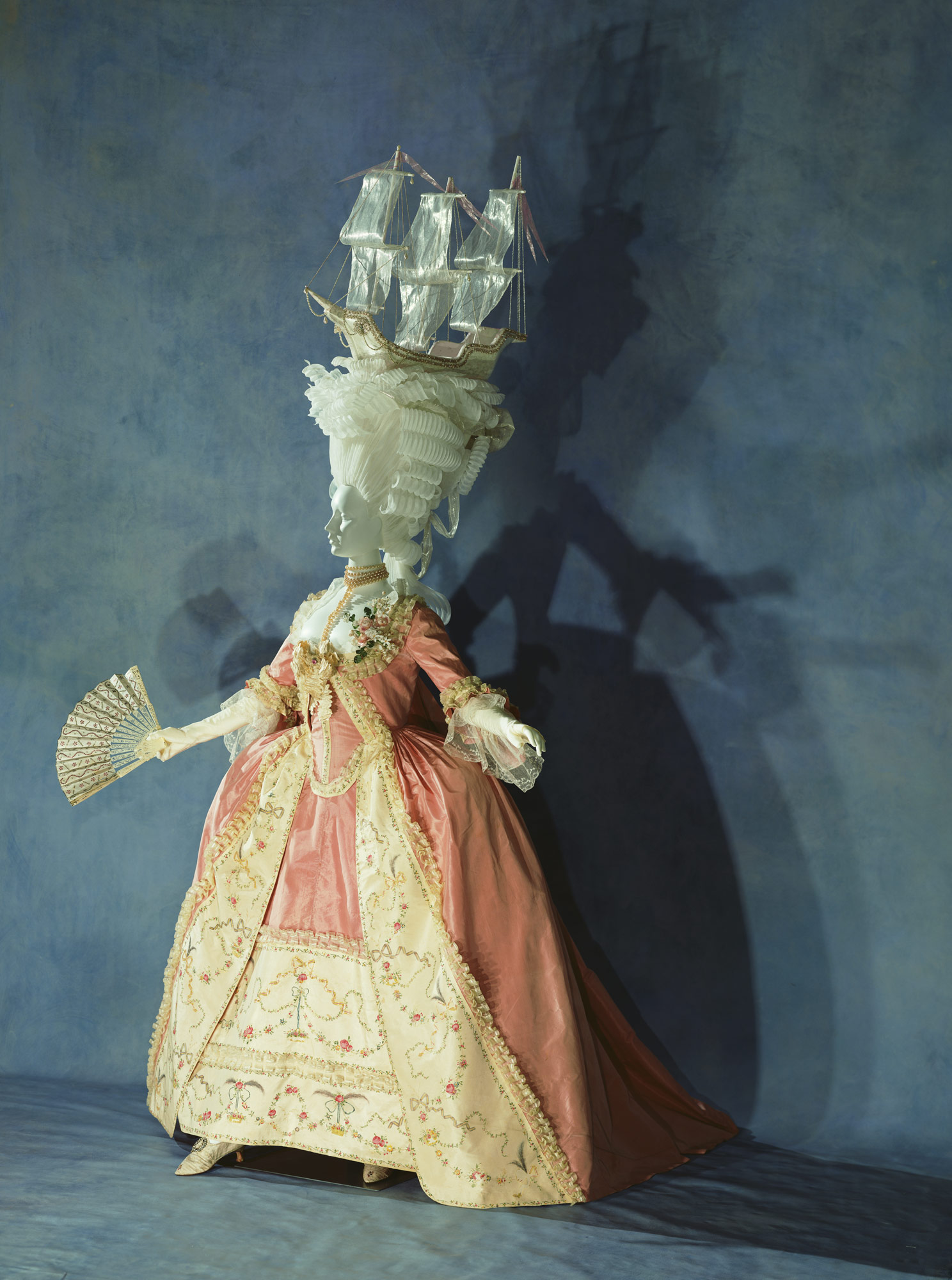
KCI Museum, described with stomacher, this is not a zone gown but a court gown, yet it has the A shaped front.

LACMA, front-closing, gorgous stripes, too!


a few more examples somewhere here: Hertzwerk Pinterest 18th century clothing

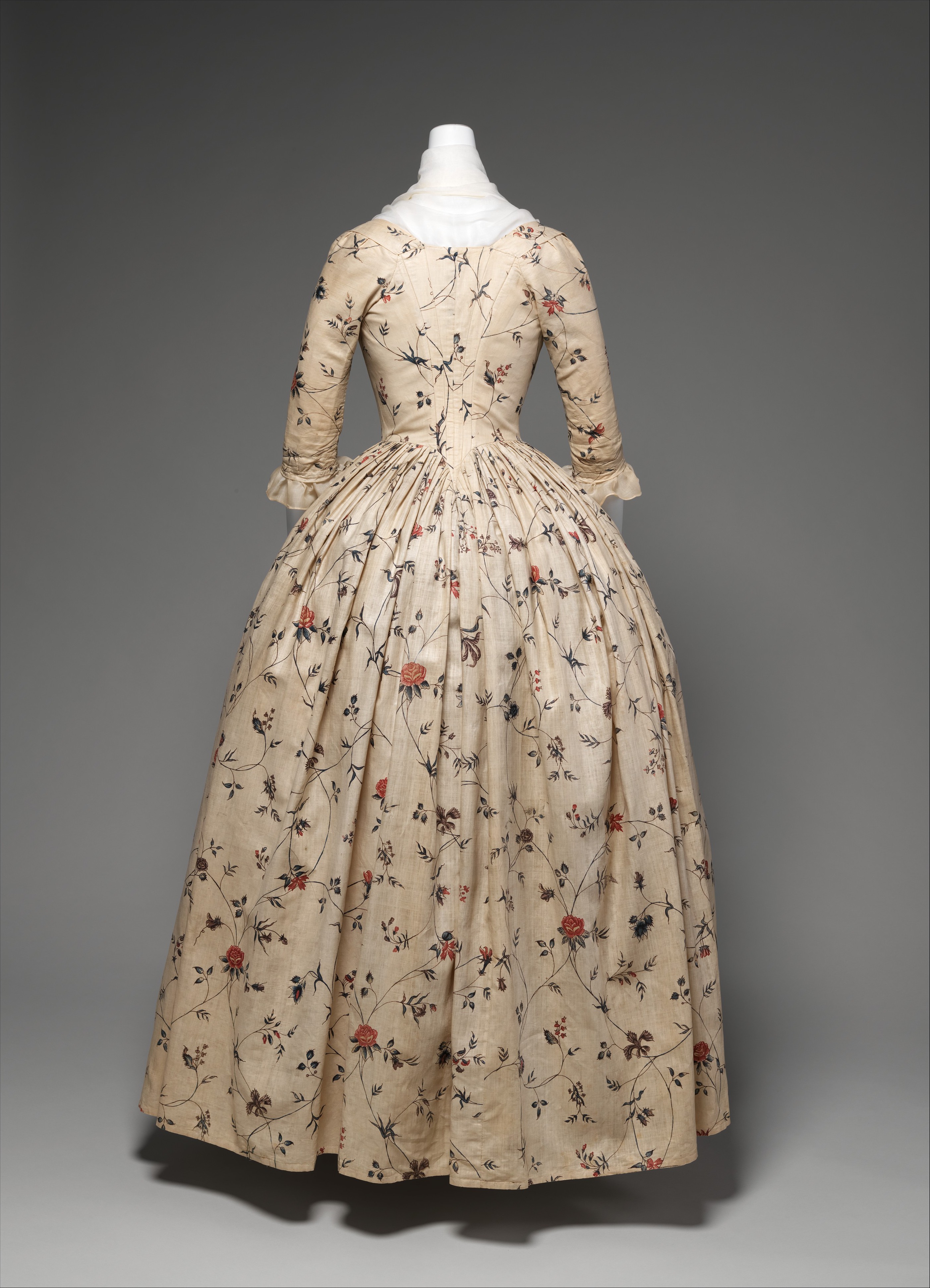
The back of the gown would have most likely looked like this, with 4 panels in the back. Although if you look at existing garments, the back can look all sorts of ways, more or less tidy, detailed, pieced... looking at Nancy Bradfield's Costume in Detail reveals that. So funnily, the more I research on how the back should look like, the more I found "anything goes". So be it.


MetMuseum 1785-95 - typical back of gown

As to sleeves... I've found them in all lengths and the direction of the stripes was apparently following the gusto of the wearer, also lengthwise stripes being possible (see LACMA Zone gown).

I will let all that information mature now see what I'll come up with.


Thursday, 19 September 2013

1730s Casaque

 For the 1730s Casaque I've not done too much researching I have to admit. I have followed Mill Farm's Pattern for the Casaque/Robe Battande and was purely inspired by this picture

Chardin, Briefesieglerin


Sorry for not draping the skirt nicer...


The most important experience I've made was sewing with stripes. I'm usually not a "patterns with directions" person but I'm somehow having a stripey phase. ;)  Anyhow, after experimenting with orderly and less orderly stripes and folds I came to the conclusion, that I didn't like the folds to be too orderly. The back would have looked horridly tidy and somehow uncoloured, that I just went for the "position of stripes by chance" method, placing the pattern on the fabric in the most economic way. It's still sort of symetrical, I didn't want to have a piece with a stripey anarchy but it's less geometrical (the orderly way reminded my of a striped sort of Mondrian...). Anyhow, this is the result, being worn over side hoops and a matching petticoat.


As for the pattern, it's Mill Farms #14.
 I have to say, I am not completely happy with the pattern. The instructions where a bit sketchy in places (I still haven't figured out, which way the front folds are actually MEANT to be pleated, the way I understood it just looked... horrid...?!) and didn't go together that well. The cuffs were not set onto the sleeves but just an extra piece continueing the sleeve. Also the order in which to assemble the Casaque was a bit... weird... All in all the pattern is ok, as in 3 out of 6 points. ;)
Being awfully German I tried to stick to the pattern as long as possible but there was SUCH a lot of tweaking involved to make it look the way I wanted it to look like. I have attached two red ribbons made out of the silk to be able to loosely close the Casaque. 


Sunday, 15 September 2013

Ballonbuks

WILD stripy body with it... next time white. ;)


I have made another Ballonbuks (Minikrea Pattern 10301) for Lucy. I have made it in size 74, but as I knew it turns out more a size 80-82 it fit her.


Saturday, 17 August 2013

lime sorbet with vodka


Not at all linked to costuming but if you are at all into making yummy things, you HAVE to try this. It is a simple yet VERY good recipe for lime sorbet I got from my sister-in-law.

500g sugar
750ml water
8 limes (finely grated zest and juice)

preparation
heat the water slowly and add the sugar, stir and heat until it is dissolved (doesn't require boiling), then add the lime juice and zest (I strongly recommend hot yet not too hot water/sugar, so the lime taste is not destroyed), it is hot enough when you have just nicely dissolved the sugar. stir well. Pour it into a container that can be put into the freezer (I've used a square IKEA plastik thingy). leave to cool for a bit, then put it into the freezer. You can stir occasionally to check the "freeze-state", but you can also just leave it there over night. Then take a nice amount and put it into a glass bowl, add about 2cl of Vodka (we found Grasovska works really well with it, but you can also try other vodka or gin or whatever you prefer) and enjoy.


http://comfortablefood.com/wp-content/uploads/2013/04/tequila-lime-sorbet-1024x685.jpg


Tuesday, 13 August 2013

Joyous summer break! pictures! yay!


Although I've not been sewing these past few months, I DO have something to show to you! it's picture time! On my small but very wonderful summer break my favourite of all photographers has taken some picture of me in historical dresses. I think they turned out nicely and I hope you enjoy them a tiny bit, too! ;)


Here some pictures of the 1750s peasant women outfit.  Tje Jacket is JP Ryan, though. ;)


The star-money...

...and this goes here, and that there, and there's SO much chaos!


Next is my black silk taffetta Francaise with stomacher, the 1750s Walpole Francaise
I've had some trouble putting the pinner cap on (and keeping it on my head...) due to the sea air blowing, so in the end I decided instead of struggling with it I'll just go totally wild and take it off. Golly!

A ship! There!

I am so NOT good at Ballet dancing.... but watch the nice Watteau back!


ALSO I have some lovely pictures of my Kyoto Anglaise en fourreau 
I just LOVE that fabric! Also featuring: the hedgehog hairdo


tututut!


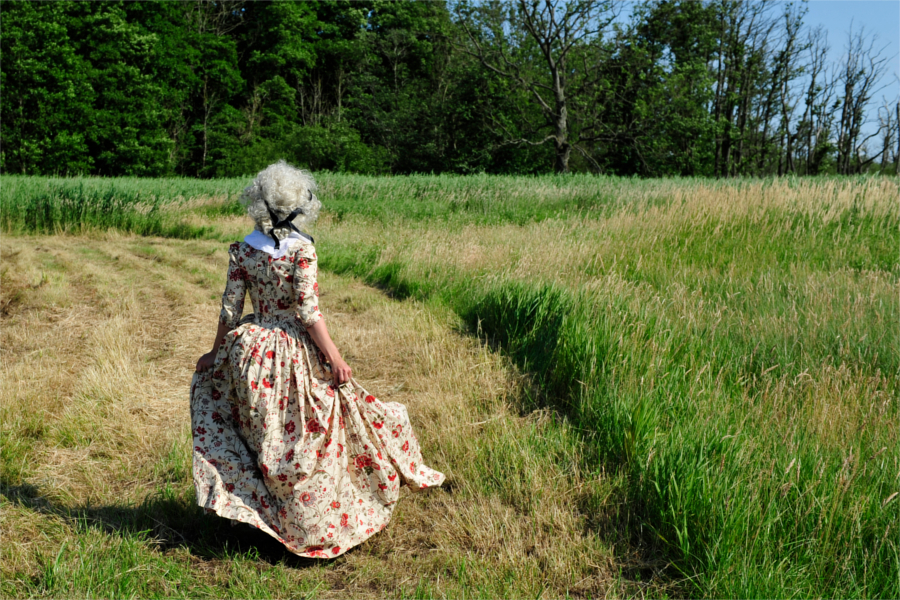
...and I will SO go into this green wall of reed and you can just watch my lovely en fourreau  backside! ;)


Just showing off my 1780s V&A stays but I DO like them and they are SO comfy!! Quite good take of the hedgehog hairdo, too. ;)


last but not least a few dainty Victorian pictures of my Laughing moon corset (the dore) and a simple victorian outfit (that I haven't made myself, I have to admit). Sorry, not hat. Forgot about that.


 reminds me a bit of this picture by Manet "nana"


Well, that's toodlepip for now, keep sewing!

Wednesday, 31 July 2013

Moving house... Umzug

We're in the middle of moving house at the moment and I have to admit, having a baby, working full time and moving house does not leave much time for sewing projects. None for the moment, in fact, as the sewing machine and all other sewing stuff has been stowed away safely
and in the middle of all these boxes I have absolutely no idea, where things are. Despite having lots of ideas what to do next (I have a few new projexts until next year) I have no idea when to sew them... but time will come...


Sunday, 26 May 2013

A rococo summer ball at Schloss Bruchsal

my favourite picture!
Hei again,

I've been busy having fun at the rococo ball at Schloss Bruchsal and enjoyed so much meeting friends again, chatting away, strolling around the palace and park, dancing (!!! yay !!!) , admiring great robes, a nice glass of wine and bubbly and, of course, wearing and discussing historical clothing. The exchange of experiences is invaluable and my head is so full of new ideas now! It was such a wonderful day and evening, thank you!
The ball did not have a specific setting timewise (anything 18th century would go). As there was no time to get changed for the ball I had to omit the idea of wearing the Walpole Francaise for the ball, sadly.
I was deciding on wearing my Kyoto Anglaise (1780s), my new V&A stays and having a go at a hedgehog 1780s/90s hairdo (wig based...).
As this was the first time ever to wear the V&A stays I was rather curious how the cane would "behave". And it was a great experience. I was prepared for the usual bit of widening of the fabric during wear, what I did not anticipate was the molding of the canes due to body heat and humidity. This material is just great! The stays shape to body nicely and are SO comfortable! Anyway, back to the ball, here's some pictures.

love the way the skirt moves and the bum :)


hug a tree!