Monday, 23 November 2015

Schloss Freudental 1775

On one of the fairest and warmest weekends of November we've had a wonderful weekend in 1775 at the stunning "Schloss Freudental" located at the Bodensee (Lake Constance).


A few pictures to illustrate the weekend.

A place to be....

(C) schloss-freudental.de

 
(C) schloss-freudental.de


(C) SoSch
Following pictures (C) Stefan Winter if not otherwise stated.  

getting up leisurely

hunting for...?

Forest walks


(C) SaMa
  I think we qualify for the next BBC costume drama! (C)SaMa

Afternoon chats  and delicious caps
meringue

chantilly cream


Louis Carrogis dit Carmontelle


Evening pleasures


the players

Monday, 16 November 2015

The "Landgravine" Anglaise - 1770s


(C) Stefan Winter
(C) Stefan Winter


Sometimes you just fall in love.


(C)Stefan Winter

(C) Stefan Winter

And so I did with this dress and this portrait...
I just had to make it.

This is the long story of the evolution of the sage green dress ("The Landgravine Dress").

that colour!!! wow!
(Portrait by J. H. Tischbein d.Ä. (?), ca 1781)

Portrait Juliane von Hessen Philippsthal
more on this Lady here:
https://de.wikipedia.org/wiki/Juliane_von_Hessen-Philippsthal
https://en.wikipedia.org/wiki/Landgravine_Juliane_of_Hesse-Philippsthal


From National Trust. I LOVE the buttons! Dated 1770
Dress National Trust Snowshill Collection/Janet Arnold PoF 1 p. 41
(also in Nancy Bradfield's "Costume in Detail" pp 59)


I have to admit, this green fabric (silk taffeta) matured on my fabric stash for quite a while, until I finally started with it. I really really love the colour. First I thought I might make an interpretation of the portrait dress, but I wasn't really sure about all that gauze ruching and the long sleeves and the front of the dress... so... that leaves nothing really... but the colour is still great!

Then I remembered that dress from Patterns of Fashion (J. Arnold) (Vol 1, p 41) (=PoF1) (and it also happens to be on the front cover...) and decided I would go that direction and, if the amount of fabric allows it, would even make a gown with trimming. My trimmings are not exactly as they are in the original. I didn't use a pinked scalloped  edge (I used zig-zag scissors, which is also ok on Pinking on Marquise.de) and I didn't make tiny box pleats but just ruched the strips of taffetta, because I think the zigzagged edge looked nicer ruched than pleated (I do think a box pleated scalloped edge is the bees-knees, though...!!)

I've always wanted to use the patterns from PoF just to try it and my first obstacle was how to enlarge those patterns.I first copied them on 1-inch-paper by hand. And because I like to try pleating in paper first before I actually do it with the fabric, I had a go at that - and totally failed the first times. So I thought I might have copied something wrong and it took me half of a day to find out how to digitalize and print those patterns.

In case you like to try it, this is how I did it:
I scanned the pattern page or part of the page from the PoF book and saved it as a jpeg. Then I used "inkscape" (freeware) to enlarge it to 800%. Then I saved that as a png. And then inserted it into a Word Excel file. And then I printed it on A4 pages with Excel. Worked a treat. If you enlarge the PoF you'll notice you don't exactly get a print-out that has 1 square = 1 inch, because it's not 100% accurate in the book either. But as is it rather unlikely that the patterns will be exactly our size, it doesn't really matter if you have 1 inch more or less. If you are perfectionist (or German, or both), you can play with the enlarging, maybe you need 810% or so. But you'll still have to do lots of fitting anyway.

So, with this newly and successfully printed out pattern I made lots and lots of folding experiments. After the first few tries I was convinced that Janet Arnold must have made a mistake in her diagramms (how very snobbishly arrogant of me...). I had another go at it again and tried lots of different things and all of a sudden it seemed to work. I think that seamstress did an extremly clever thing when she was doing those pleats.(Unless J.A. actually did make a mistake and this is just how it turns out...)

The main problem was, that the folding instructions in PoF were rudimentary, apart from the general direction ("it's a box pleat") it doesn't tell you much. And the drawing isn't really a  big help, either.

The same dress can also be seen in "Costume in Detail" by Nancy Bradfield, p.59. While trying and failing with those pleats I looked at PoF and CiD again and again for guidance, only to find that the description and drawings of the dress somewhat differ in the two books. I'd love to have a look at the original gown, really.
I've come up with a solution that works and looks nice, as I've not had the chance to look at the original dress I can't tell you whether it is right, but I am positive that it is entirely possible. :)


Pleating guide (xps file, easy to open in internet explorer)

https://goo.gl/IEF0lR


After I had sussed out the pleating guide and I had enlarged the pattern anyway, I made a quick mock-up of the original pattern bodice. Of course it wasn't my size, the lady was a bit larger than me, especially in the shoulder area. And she was a good deal taller, too. Also I found that I didn't really like the look of the side seam (front to side back panel) so I got the pattern for my zone-gown out (basically a variation of JP Ryans Anglaise Pattern) and made a few changes to it. The back is four gored, but it is narrower/more parallel in the waist. The neckline is also a little lower. The front, obviously, is a "normal" Anglaise front. I didn't used hooks and eyes, i like to close the gowns with needles.

As an inspiration for the back panels I looked at this dress
http://www.metmuseum.org/collection/the-collection-online/search/159201?img=2 

If you have the chance to browse throught Nancy Bradfield's "Costume in Detail" or just have a look at one of the large museums' online collections, you will see, that all sorts of back panel alignment solutions, grainline and sleeve insertions were used, it's really mad and exciting.

I also made light changes to the sleeves, but that's just positions of the pleats at the shoulder, dart at the elbow and a tad tighter around the elbow. I don't really like lots of pleats around the shoulder seam ("puffy sleeves) but at the same time I am moving around a lot (wildly gesticulating, obviously) and need the "space" there to feel comfortable. I didn't add wide trimming because I ran out of fabric and just added a small ruffle at the bottom edge of the sleeve.

To wear the Robe à l'Anglaise à la Polonaise I have attached 3 loops inside the Anglaise. Again, there are various ways of looping up the skirt, 2 or 3 ribbons, loops, ties, buttons....all sorts.
I don't mean the dress as a full proper "Polonaise", I want it mainly for pulling the skirt up for dancing.
I suppose loops inside with buttons outside would be easier to loop up for a spontaneous dance, but after initially contemplating about 2  buttons outside, i tried it and it sort of took the "ooomph" away from the back pleats. 


I also decided I needed  new hair with the dress...

The big hair tutorial here: 
http://hertzwerk-freiburg.blogspot.de/2015/10/1770s-big-hair-wig-tutorial.html


A word on my sources

To create this dress, I used 4 sources

- The portrait of Juliane von Hessen-Phillipsburg (for the colour mainly... the portrait is from 1781)
- The picture of the original dress in the Snowshill collection (only 1 front view, dated 1770)
- Janet Arnold "Pattern of Fashion Vol. 1"
- Nancy Bradfield "Costume in Detail"

The portrait shows the overall appearance and proves the existance of the sage green colour. And the big hair.

The picture of the Original dress gives a feelin for the dress (albeit being a completely different colour) but there are no details or close-ups.

And here started the problems

Nancy Bradfield and Janet Arnold (both accredited authors and publications) had a close look at the same dress. Or so you would think.

- Janet Arnold suggests the dress would be worn "retroussee dans les poches" but there are no pocket slits where you could pull it through in the pattern. She also didn't mark or mention any loops for looping the dress up "a la Polonaise". She does indicate a front closure with hooks and eyes though. Her pattern shows the pleating of the dress in detail.

-Nancy Bradfield's beautiful drawings and descriptions somewhat differ from that. Her pleating guide for the skirt depicts just normal box pleats. She didn't observe any front closure or traces thereof. She does indicate where the dress was looped up to wear it "a la Polonaise".

Both mention that the sleeves show traces of a sleeve ruffle, but none of them indicate where ... they both suggest a broad ruffle though, so I suppose the traces of stitching must be wide.

this is just to state, what "research" would include. If I had intended to exactly reproduce the dress from the sources at hand I couldn't have done that, because they were contradictory (there are more details e.g. the size of the buttons, that aren't the same).


A short note on dating the gown: Robes a l'anglaise came really into fashion in the 1770s. There are a few Robe Anglaise/en fourreau from the late 1760s, but mainly it's 1770s thing. As the first partition of Poland happened in 1772, the style of Robe a la Polonaise or the fashion of wearing the Robe a l'Anglaise a la Polonaise could only develop after that. Although refashioning a simple Robe a l'anglaise into a Polonaise (by attaching a few strings) is so easy... so it is really difficult, to date the robe and the museum doesn't give us any hint, why they suppose such an early date for this plain Anglaise. So we must assume that the owner was either a fashion connaisseur, or the anglaise is of a later date (more mid 1770s).

Tuesday, 10 November 2015

Cloche Fever! - Autumn is great for hats!


 Novembre as begun and autumn weather has really reached us. Some days are pure gold, with sunshine, warm temperatures (still 20 degrees Celsius!) and clear blue skies. Others are grey, foggy and wet and you don't see the sun no matter how hard you try. And others are a bit of both, which I like best. When in the morning the fog lifts with the first rays of lights and seems to flow over the tops of the hills and retreat slowly, then comes back a bit, and then by early afternoon the sun has taken over and warms the skin and face.

Anyway, it inspired me to make some more cloches.

The light blue "bluebell" cloche seems to be more suitable for lighter days. I have to admit - light blue isn't really my colour... I do like the outcome though. I also start to like hats in weird colours, because  usually wear black (happy black, of course) and the coloured hats are a nice contrast. light blue also suits my complexion and eyes (says my husband, who also said "look, I would REALLY tell you if it wouldn't look good, don't worry), so I'll go with that. It reminds me a bit of my great-grandmother. The story goes, that when she went shopping for clothes and the shop keeper was telling her how wonderful the coat (or whatever) looked and she didn't really like it, she would say "yes, it definitely makes a small foot". And whoever accompanied her on the shopping day, would know what she meant by that. I assume it is another way of saying "the rest of me looks enormous in this coat".

awww, what a friendly creature!!

Maybe I will add feathers to this side... later...


This is the other hat I made. ACTUALLY I love it. It is great. It's the first hat in a non-weird colour and I like the outcome. Maybe I will reshape the bluebell cloche (or add a feather that crossed from left to the middle or something, it defnitely needs a little more "pzazz").


It is inspired by hats made by this talented lady http://behidadolic.com/   She used to do lots of free form felting on a simple balsa block, lots of cloches or smaller hats. It seems her newer creations (now also in "straw" for summer) are made more and more on special hat blocks, which I find really sad, I love her free form felt hats.

bonus material. :)

Monday, 26 October 2015

1770s big hair - a wig tutorial

When I made this wig, I didn't take any pictures, unfortunately, because I wasn't even sure how it would turn out. It turned out well (I think) and now I am a bit annoyed I have no pictures for a proper tutorial. I did a few drawings instead and am trying to describe what I was doing and how. If there are any problems, just let me know, maybe I can explain better. Also for the moment I haven't got better pictures, but I promise to add them ASAP. I wanted to get the tutorial out as soon as possible. :)

Pictures with very silly big cap and sockets. :)


I've made the instructions on paper, you can view and download them as a pdf. :)

https://goo.gl/EtF239


I have used

mesh wire
about 20x30cms
The holes are about 2-3cms (1 inch) wide


2 wigs (long hair, wavy or curly, no fringe; I have used lace front, but that's up to you; be careful with the colour, I have chosen something that is sort of similar to my own hair, and yes, it is synthetic.)

batting for the mesh wire "cage" (I used a piece of Vlieseline H640, because it was there. Just choose something that is softish to cover the "cage").

lots of pins
enormous amounts of hair spray and a bit of foam
lots of patience


You can find inspiration for hairdos on paintings and I found these drawings quite helpful. http://www.coiffure-ducher.fr/louisxvi_femdescr.html

As usual, I didn't copy anything in particular but just "absorbed" all the sources and then made something up that I think works for the 1770s. I have to admit though, that I might have looks at mid 20th century hairdos, I don't know why, I think I have made a set of victory rolls there... I like anachronisms though. And again it shows how much we are children of our own time...

I hope the tutorial is helpful, if you have any questions, just leave a comment below. 


wearing experience: after wearing the wig for an entire evening, I now know, why posture was so essential "back then". Despite my wig being very well secured to my head and reasonably well balanced, it does have quite a bit of weight and being a rather lively person (pulling faces, turning my head quickly ....) I felt it forced me to move more ... elegant... and slower... and while it suited the evening and the whole ensemble (the "Landgravine Anglaise"), I wouldn't want to wear it on a daily basis. I am too 21st century. ;)


Monday, 5 October 2015

With Flying Colours...!!!

 My dear readers,

today I would like to share with you the work of an incredibly talented and lovely lady, who is making superb accessories for historical reenactment, that will make the difference between "nice" and "wow". Everything is really well researched and tested on Germans. Believe me.:) Visit her on her facebook page: Flying Colours

Everything is handmade in Germany, but postage is no problem. Come and enjoy a few pictures of her work.

You need a walking stick? Something like this?

Walking Cane modelled after 18 century fashion
pewter knob and wooden cane with mahagony/shellack finish
130cm 60€

She does custom knobs, too. ;)


top of handpainted walking stick


Maybe you are reclining in the shade on a hot day... and need a fan?


Or you need a miniature of your beloved?


or just a caring eye?


important things in a nutshell

(reconstruction from actual historical piece!)
store your little thingys in style


threading nicely!


there is no reason why you shouldn't do your writing in pure style, either!


(more designs available)
you wouldt want to hide this ink! And i'm sure it improves handwriting, too!
Ah, you're more reading-type of person... authentically no problem! Super bookmarks!


to plan your next field trip....


or a night cat


have a historical cup of coffee or tea (with excellent sense of humour!)


or make a stand with these regency ladies!


Again: check her fb page https://www.facebook.com/flyingcoloursger/photos_stream?tab=photos_albums
or get in touch with her for custom orders. oh, and you know what? Not only you get unique items at really good prices and you support a craftswoman with know-how and love for her work. Like and share her page if you like what you see and spread the word! Thank you!

Friday, 11 September 2015

The "Duck à l'orange" Cloche

Another cloche in a colour that will definitely make car drivers see me in winter. :) For no real reason (other than the strikingly orange colour, obviously) it became the "Duck a l'orange" cloche.
This time I've planned the positions of the pleating a bit more careful, used stainless steel super fine needles and didn't brush as vigorously. :)


my skills considering hair-dos definitely need seeing to...


I still have a lot to learn about the free from felting but I think I am getting somewhere. Even the weather has changed - from nearly 40 degrees celsius to about 24 degrees. :) Autumn is definitely on its way!

Normally I wouldn't choose orange, but I do like the cloche, although I am not sure, whether orange really suits my complexion. Nevertheless, I guess in winter it will look nice with a  black coat. 

Sunday, 6 September 2015

Danish Chemise Dress - Tutorial

Because I am so in love with this light, airy, elegant Chemise Dress and there is a free pattern available on the Museum homepage here  http://natmus.dk/historisk-viden/temaer/modens-historie/1790-1840/hvid-brudekjole/


I thought I'd write a small tutorial how to assemble the dress - because all of the info on the pattern is in Danish.


http://natmus.dk/historisk-viden/temaer/modens-historie/1790-1840/hvid-brudekjole/

So, after you've downloaded the pdf I suggest you do this to get something to work with:


1.Copy the museum's pdf into inkscape
2. Enlarge it so the boxes are 5cms wide (about 2 inches)
3. Save it as a .png
4. Copy that it into a Word Excel file (adjust the pages so there is hardly any margin, other wise you just have tons of overlap and waste paper...)
5. Print. I printed only the pages with the bodice pieces, and the top pleats of the skirt to safe paper, because the length of the skirt I have to determine anyway after finishing the bodice piece. And you can also measure that on the pdf.
6. Make a print-out of the Museum's pdf, too, so you know how to assemble your paper.
7. Don't forget to save the pdf to your computer, in case the museum's page goes down or so... :)


Now you've got a pattern for a lovely gown
- The underbust measurement is 67-70cms (about 26,5-28 inches)
- Chest is about 80-83 cms (about 31,5-32,5 inches)
- Length from underbust middle to floor: 115cm (45inch), back middle waist seam to floor about 136cms (53inch)
- bust point about 25cms
- back width about 30cms (12 inches)

Obviously, if these aren't your measurements, you've got to adjust the bodice. If you've never made that before, maybe this isn't the right project to start. You should know how to adjust stuff and have a bit of experience with sewing. I recommend sewing this by hand, it's easiest. also carefully mark and match.

Make a mock-up, at least of the bodice and the bodice-cover and the draping and sleeves, so you understand how the pleating works and where you might need to make further changes before cutting your nice favourite fabric. Especially the sleeves need attention, because they are set deeply into the back and have no folds or tucks to give enough space.

To be worn over appropriate underwear. (e.g. bodiced petticoat, short stays...)


Fabric required:
At least 6meters of thin cotton batist or voile or something comparable. About 50cms of thin canvas or thin twill or other suitable fabric for the bodice base.

Cut out the bodice cover and bodice base (don't forget the seam allowances).

bodice base assembly
center backs together. The original has a 6cms long piece of string or small band attached to the center back inside. Then proceed  with side back, sides and fronts. Attach shoulder strap only at the front.
The original has a tunnel with a string at the front, which I omitted.
Finish all visible (and if you want all invisible) hems. Sew the eyelets by hand. Use buttonhole stitch and poke throught the future-eyelet-hole with an awl after every stitch. Insert string. Try the bodice on before you proceed.

Bodice cover assembly
Center backs together and then sides. Attach shoulder straps at front only. Follow pleating guide to make it lie nicely on the bodice base and wing it a bit here. The front flaps overlap a little to cover the eyelet fastening. Don't forget to make the pleat "K". The double pleats are attached with only one seams on the bodice base as you can see on the picture.

Now the bodice base and cover should be assembled and you try them on and attach the shoulder straps together in the right place.

Finish remaining seams. 

Sleeves
Sew together sleeve and sleeve lining and treat as one. Set in sleeves by hand by easing them in, they go in quite wide into the back, but that's part of the fun. Finish sleeve hems.

Front draping
Again, make a mock-up first to understand the pleating. Then pleat the 2 sides, iron nicely and stitch together at the two lines "F" and just about "H".  Stitch Center Back (will be a slight V-shape) and mount on a piece of band, about 1,5cms wide, from "D" to "E". (I've used twill tape, Petersham should work nicely, too, something that gives it a bit of stability). Attach the back and sides to the Bodice where indicated on the pattern. Make sure to leave enough space at the bottom to attach to the Front Skirt. Finish all other hems.

Skirts
Cut the skirts, sew back and front together and pleat according to pleating guide, to match back and sides. Attach the front panels to the Front Draping only, not to the bodice and make the seam wide enough to create a tunnel for the drawstrings. Then attach the back panel on the bodice from point B to C. Finish all hems, the original has a 7mm ribbon at the side "pocket opening" and at the bottom.

Insert string in front and attach.

I hope this could help you, if you have any problems, just ask.

Again, here is the link to my gown. (And I know already what I sould have done differently...)
http://hertzwerk-freiburg.blogspot.de/2015/09/danish-chemise-dress-1790s.html

Thursday, 3 September 2015

Danish Chemise dress 1790s - Danish National Museum


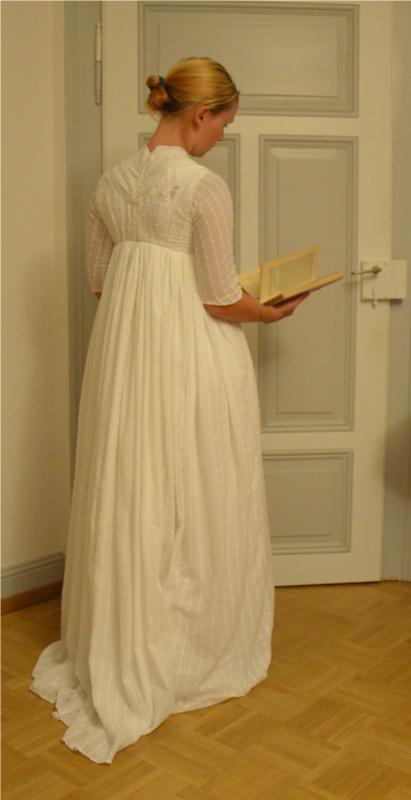
I've finally finished my "Danish Dress". It's about 99% handsewn, which is a first for me. :) And I like it SOOOO much. I love the way it is drafted and assembled, I am absolutely awstruck and I think the seamstress that made the dress was ingenious.


The Original dress: (more picture of my version futher below...)

http://natmus.dk/historisk-viden/temaer/modens-historie/1790-1840/hvid-brudekjole/

I had seen this lovely dress quite a while ago and wanted to make it. I had a bit of black voile left, so I considered remaking it in black.  if you want to know more about Chemise Gowns in black hop over to Festive Attyre http://www.festiveattyre.com/search/label/chemise%20gown)

Anyway, as you can see from the pictures, I didn't choose black fabric, because whilst searching for that, I stumbled across Matilda ... a lovely fabric from our favourite Swedish furniture shop. Matilda is a very sheer cotton curtain  (yes!!) with white stripes with bobbles woven into the fabric. I love it.

The dress is from the Danish National Museum in Kopenhagen.
http://natmus.dk/historisk-viden/temaer/modens-historie/1790-1840/hvid-brudekjole/
They even deliver the free pattern (taken from the actual dress, like e.g. Janet Arnold PoF)
http://natmus.dk/fileadmin/user_upload/natmus/historisk-viden/modens-historie/snitmoenster/hvid-brudekjole.pdf

The Museum dates it to "ca. 1797", but as they seem to know that it was Eleonora Sophie Baroness Rantzau's wedding dress and she married 1796, I suppose the date should be "ca 1796".

When I made the Mock-up, I found, that I could wear the pattern without many alterations. Just the sleeves needed slight adjustment and the length of the skirt. I felt a certain connection and wanted to know more about the lady, who wore this for her wedding. Also, I was brought up in Northern Germany, only 45min away from the Danish border and 3 hours from Kopenhagen. And my great grandfather is Danish. 

This is Eleonora Sophie Baronesse Rantzau:
http://finnholbek.dk/genealogy/showmedia.php?mediaID=269&medialinkID=570

She was born on the 24th August 1779 in Fjellebro Gods, that is on the island Odense (in Denmark, of course).  She was the second of 3 children, she had an older brother and a younger sister. When she was 16 (1st July 1796), she married Preben I. lensgreve Bille-Brahe (who 22 years old at the time). They had 2 children, Henrik lensgreve Bille-Brahe, (b. 21 Jan 1798) and  Frederik (Fritz) Siegfred baron Bille-Brahe (b. 26 Feb 1799). Her children were named after her father in law (Henrik) and possibly her father (Friederich Siegfried).
Only about a year after the birth of her second son, Eleonora died on the 21st of August 1800 aged 20 (that's only 3 days before her 21st birthday in fact, and also our wedding day, which is a bit creepy, but well, life's full of weird coincidences...). I couldn't find out the reason for her early death. I could imagine childbirth or pneumonia.
Her husband married again - 16 years later, a lady called Johanne Caroline Vilhelmine Falbe. They called their first born daughter Eleonora Sophie. Isn't that romantic? This is a picture of the couple a year after they married.

http://finnholbek.dk/genealogy/showmedia.php?mediaID=2346&medialinkID=25470

She died in 1823, and a year later he married another lady called Birgitte (Betzy) Susanne Sybilla komtesse Schaffalitzky de Muckadell  (b 1801) (wow, that name rocks!). But enough genealogy, if you are so madly interested, follow the links below for further information, because that's were I've got it from (including pictures)

http://finnholbek.dk/genealogy/family.php?familyID=F4376&tree=2
http://finnholbek.dk/genealogy/getperson.php?personID=I8847&tree=2
http://skeel.info/getperson.php?personID=I4890&tree=ks (look for Person ID I4890)
A little on the actual dressmaking:

The assembly of the dress is relatively straight forward, a big "thank you" to Mariell from https://www.facebook.com/Geschichtsgewaender// for her help with the translation of the Danish Annotations... the most important one is "the drawings are not too accurate, sometimes there is up to 2 mm difference and maybe more" or something like that. I have written a short tutorial here http://hertzwerk-freiburg.blogspot.de/2015/09/danish-dress-tutorial.html

I am wearing a white bodiced petticoat (La Mode Bagatelle) under the dress, which for me replaces the stays. I suppose to do it properly I should make a pair of transitional stays but that's another future project. Unfortunately the straps of the bodiced petticoat show through the sheer fabric (which reminds me: I should have made a lining, like in the original... never try to be more intelligent that an 18th century seamstress.... at least not this one, the dress was made in a extremely ingenious way). (If I make the dress again, I would line the fabric... or maybe I take the sleeves off and line them... or so...)

Finally, pictures!!


back view, with a very bad hair day and stupid straps destroying the wonderful inwards setting of the sleeves. :( The sleeves are very beautiful and I think I will use the pattern for more 18th century sleeves in the future. They don't need darts yet fit comfortable (hence the wrinkles under the arms...))


Love letters (The one from Guy the Maupassant was great, albeit being anachronistic!)

I am poking my nose up other people's love letters.

This is dedicated to https://www.pinterest.com/festiveattyre/regency-ladies-wedgie-society/


I also want to tell you a little story about the book I am holding in the pictures. It is a wonderful book called "Briefe der Liebe" (Letters of love), edited by Camill Hoffmann https://de.wikipedia.org/wiki/Camill_Hoffmann and some more about him here (in German language) http://www.radio.cz/de/rubrik/kultur/camill-hoffmann-botschafter-zweier-kulturen
The book was given by my great-grand-father to his then-fiancée for their engagement. This took place at Christmas 1912 (he wrote the date at the beginning of the book). It is love letters from the early 1700s to the late 1800s. And the choice of letters is wonderful. But here the romantic parts ends. Camill Hoffmann was killed in Auschwitz in 1944 together with his wife Irma. Life is bittersweet. If you can read German, try to get your hands on a copy. Or recreate the Danish Dress. Or both.


Have a great evening!

Hertzwerk X